
Margaret Cavendish, Duchess of Newcastle-upon-Tyne
 “If I am condemned, I shall be annihilated to nothing: but my ambition is such, as I would either be a world, or nothing.”
– Poems (1653), dedication to “To Natural Philosophers”
Margaret Cavendish was a seventeenth-century philosopher, playwright, poet, orator, and fiction writer. She was prolific, publishing more than a dozen original works during her lifetime. Unlike most women writers during this time, Cavendish published under her own name, with her portrait proudly engraved on the frontispieces of her work. Although Cavendish never received a formal education, she regularly engaged in philosophical discussions with her brother James, her husband William, and his brother Charles. Through William, Cavendish attended meetings of the “Cavendish Circle” where she was able to meet some of the best minds of her time including René Descartes, Thomas Hobbes, Henry More, Kenelm Digby, Pierre Gassendi, Walter Charleton, and Joseph Glanvill. Although Cavendish did not participate in the meetings, she grappled with the views of these thinkers and the philosophical issues they discussed throughout her work. Cavendish was also the first woman to be formally invited to visit the Royal Society, despite pushback from many of its members. Here, she witnessed the famous air pump experiments of Robert Boyle. At a time when many women writers were concerned predominantly with issues of religion, or the education of women, Cavendish focused primarily on natural philosophy and constructed original arguments against the dominant materialist, mechanist and dualist theories of substance and causation. Extravagant and eccentric, “mad Madge” stands alone as one of the few early modern women – the list also includes Du Châtelet – who was bold enough to stake out her original philosophical positions in a non-anonymous way, even at the risk of public ridicule.
| Preferred citation and a full list of contributors to this entry can be found on the Citation & Credits page. |
1. Biography
In 1623, Margaret Cavendish (neé Lucas) was born into a wealthy aristocratic family, the youngest of the eight children of Sir Thomas Lucas and Elizabeth Leighton Lucas. She was primarily raised by her mother as her father died when she was very young. Her education was typical for young ladies of her time, consisting of learning to read and write, to dance, and to sing. However, these lessons, Cavendish says, were inconsistent and more of a formality than of true benefit. She received no formal education in science or philosophy, nor in any of the academic languages, such as Greek or Latin. Unlike some aristocratic women of the time, such as Princess Elisabeth of Bohemia, she did not receive private tutoring in natural philosophy, and unlike Masham or Conway, she did not have a philosophical mentor. She was, however, precocious from an early age and having access to private scholarly libraries made up for her lack of education. Her self-directed studies were supplemented by discussions with her brother John, who was a scholar of philosophy and natural science, and who was fluent in Hebrew, Latin, and Greek. John later became one of the founding fathers of the Royal Society. Cavendish worried that her lack of formal education would affect the quality of her work and she very often publicly decried this handicap in her texts. Additionally, despite her future notoriety as eccentric, extravagant, and “mad,” she was very shy in her youth. As a child, Cavendish spent most of her time taking long walks “in a musing, considering, contemplating manner, reasoning with [herself] of everything [her] senses did present.” Cavendish felt that being introverted in this way was a “natural defect” and although she tried to overcome her shyness, it was ultimately “difficult to root out.” (Cavendish 1656, 167).
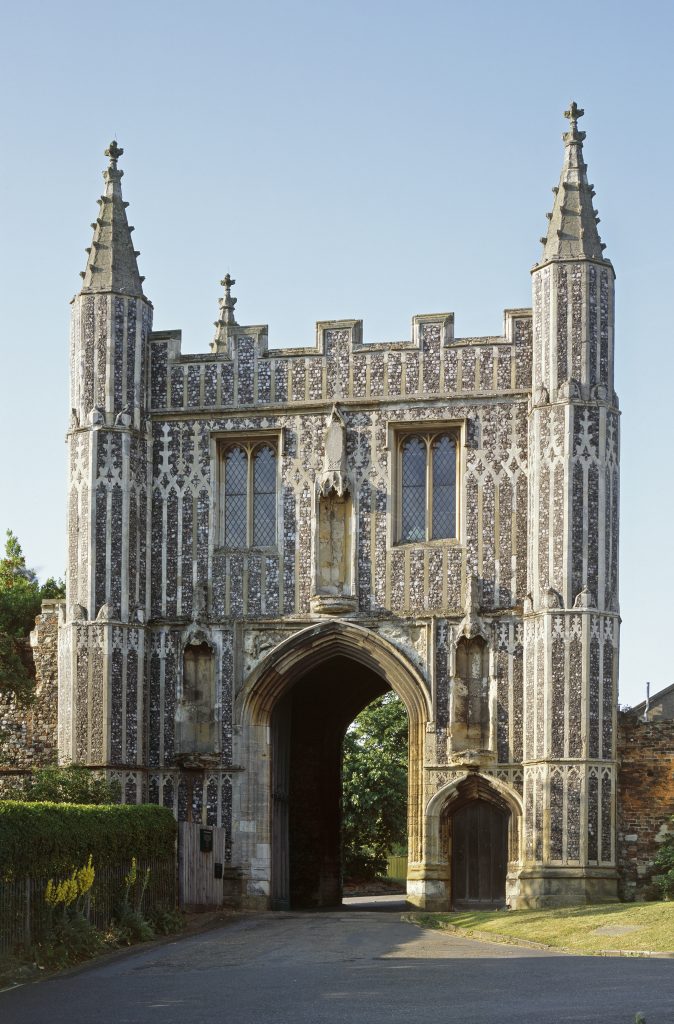
Before Cavendish’s birth, the Lucas family aligned with the monarchy and as a result, during the English Civil War in 1642, their home at St. John’s Abbey was attacked by rebels and her family’s tomb was desecrated. Left without a dowry due to her father’s early death, in 1643, Cavendish applied to become the maid of Queen Henrietta Maria, the Catholic wife of the soon to be executed King Charles I, and the mother of the future kings Charles II and James II. The tumultuous Civil War greatly impacted Cavendish and her work. Throughout her natural philosophy, for example, Cavendish uses war and civil disobedience as analogies for the disorder and irregularity found in the natural world. In 1644, following more political disturbances in England, Cavendish followed the Queen from Oxford to exile in Paris. There she met her future husband William Cavendish (1593–1676), who later became the Duke of Newcastle. Cavendish’s marriage match proved to be intellectually, as well as socially, important for her. Her well-established and influential husband, thirty years her senior, had received tutoring from Thomas Hobbes as a child and was very much interested in philosophy.

During their three-year sojourn in Paris from 1645 to 1648, William introduced Cavendish to an intellectual circle of both French and English scholars in exile, which soon became known as the “Newcastle” or the “Cavendish” Circle. Members included English philosophers such as Thomas Hobbes, Kenelm Digby, and Walter Charleton, and French philosophers such as René Descartes, Pierre Gassendi, and Marin Mersenne. The circle was also very well connected outside of Paris: William’s brother Charles Cavendish, for example, was personally acquainted with Princess Elisabeth of Bohemia, who in turn corresponded with Descartes, and also commented on Digby’s views. Other notable women of the time, such as Queen Christina of Sweden, whom Descartes would later tutor, and Anna Maria van Schurman, were in communication with Gassendi and Mersenne. The new mechanical philosophy discussed by these philosophers left a deep impression upon Cavendish, inspiring her to pursue natural philosophy.
Not only did William introduce Cavendish to some of the most famous philosophers of the day, he also helped her publish her own work. By the time she returned with her husband to Restoration England in 1660, she had already penned five texts, including Poems and Fancies (1653), Philosophical Fancies (1653), and Philosophical and Physical Opinions (1655), in which she lays the groundwork for her alternative to the new mechanical philosophy. Many of Cavendish’s works include a dedicatory epistle to her husband or a preface by him, which, in some eyes, lent the works an air of respectability. Still, it was highly unusual at the time for a woman to publish on topics in natural philosophy, and also unusual for her to publish under her own name.
Although Cavendish was eager to engage in the discourse, her work was often mocked or ignored. For example, after receiving copies of her books on natural philosophy, Henry More, a member of the Royal Society, wrote to Anne Conway that Cavendish “may be secure from anyone giving her the trouble of a reply.” (Conway Letters, 1992). Perhaps due to this silence, Cavendish famously took it upon herself to deliver her work as gifts to well known scholars at universities such as Oxford and Cambridge. When she was invited to engage in philosophical conversations, she excitedly discussed prominent scientific discoveries of the time. In 1657, for example, she corresponded with Constantijn Huygens on the topic of Prince Rupert’s Drops, glass objects that were characterized by a curious combination of strength and fragility (See Conway Letters, 1992).
During the 1660s, Cavendish took an interest in the work of experimental philosophers like Robert Boyle, the curator of experiments at the Royal Society, Robert Hooke, and Henry Power. On May 30th, 1667, she gained even more notoriety for being the first woman to attend a meeting of the Society. Cavendish not only attended, but she was formally invited, partly due to the intervention of her friend Walter Charleton, who lobbied on her behalf. At the Society, she observed Robert Boyle’s experiments with the air pump, and his experiments with mixing colours, with the assistance of Robert Hooke. She was delighted. The visit caused such a sensation that Samuel Pepys thought it worthy of an entry in his Diary: “That which we, and almost all went for, was to see my Lady Newcastle; which we could not, she being followed and crowded upon by coaches all the way she went, that nobody could come near her; only I could see she was in a large black coach, adorned with silver instead of gold, and so white curtains, and every thing black and white, and herself in her cap, but other parts I could not make [out]” (Pepys, 1667).”
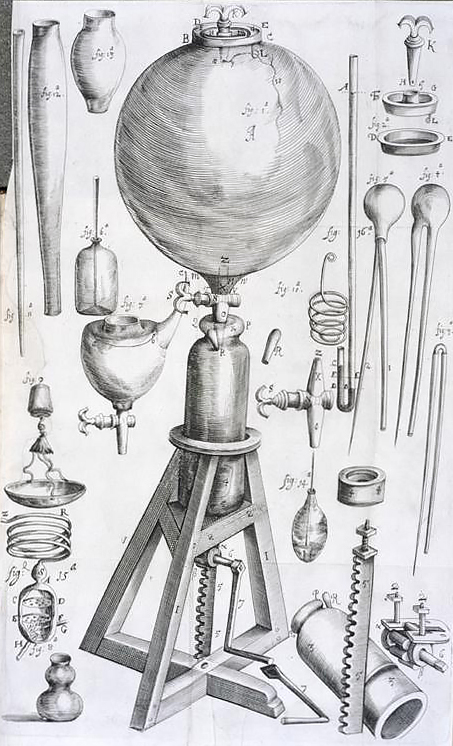
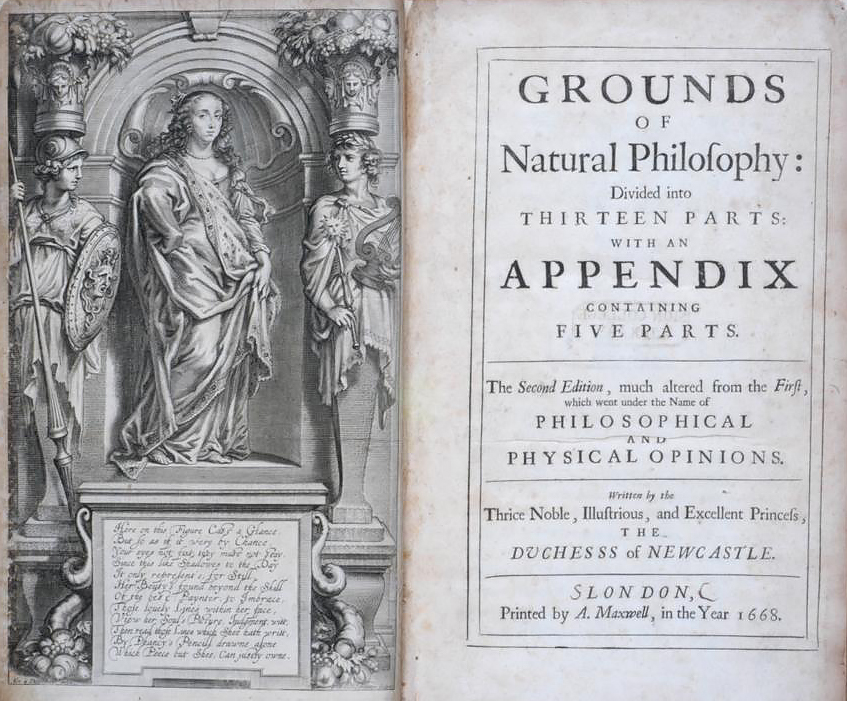
After her return to England, Cavendish busied herself with reading the latest works in natural philosophy. She read Charleton, Descartes, Digby, Hobbes, and J.B. Van Helmont, considering topics as varied as dioptrics, hydrostatics, and magnetic theory. She also pursued readings in ancient philosophy. By 1668, she had published – publicly and with her name and portrait proudly displayed on the frontispieces – thirteen works ranging from treatises, fiction, plays, and a biography of her husband (which proved very popular and was subsequently reprinted many times). By the time of her death in 1673, Cavendish had developed an overarching position that was unique in the philosophical landscape of her time. Her philosophical views are presented in her works Poems and Fancies (1653), Philosophical Fancies (1653), Philosophical and Physical Opinions (1655), Philosophical Letters (1664), Observations Upon Experimental Philosophy (1666), and Grounds of Natural Philosophy (1668), among others. In these works, she discusses Cartesian dualism, the materialism of Hobbes, and mechanist views of nature and of causation. Cavendish stakes out a new position distinguished from both the dualism and the materialism of her contemporaries.
Dressing lavishly and acting with an affected manner, she acquired a reputation for being eccentric and extravagant, and altogether too bold for someone of her sex. She was a society phenomenon, a prolific writer, and a serious philosopher whose work was largely unappreciated in her time.
Fortunately, philosophical interest in Cavendish has increased significantly over the last few decades. The rapidly growing secondary literature on her philosophy might even begin to satisfy Cavendish’s own hopes for the future of her work. In Observations Upon Experimental Philosophy, Cavendish imagines how her ideas will be received throughout the course of time: “If she be slighted now and buried in silence, she may perhaps rise more gloriously hereafter; for her ground being sense and reason, she may meet an age where she will be more regarded, than she is in this” (Cavendish 1668, 13).
For image sources and permissions, see our image gallery.
1.2 Portraits
Cavendish’s publications stand out not only because of their number (thirteen in total), but also because they visually represent a campaign of public self-promotion rare among women authors of the time. Cavendish not only self-published lavish presentation volumes, but she had many of the frontispieces engraved with her portraits – leaving no one in doubt as to the author. Unlike Conway and Masham, who cultivated socially acceptable anonymity, she unabashedly sought publicity.
Historical context
To put Cavendish’s publications in context, in the sixteenth and seventeenth century, the number of women whose works were published in print increased to the hundreds. However, most of these works were not published in quarto or folio format – what we would today think of as “book” and “large book” formats. According to Jane Stevenson, “well over half of seventeenth-century women’s ventures into print – approximately 60% – belong to the level of printing which was only one step up from the broadsheet ballad: pamphlets which amounted to one or one-and-a-half sheets cut and folded.” (Stevenson, 2009, pg. 207)
This would not do for Cavendish. As a wealthy aristocrat, she did not need to publish for financial gain; rather, self-published in order to gain widespread recognition from philosophers and academics. To give her works respectability, she published them in a format expected for scholarly works, the kind that would be included in university libraries, and commissioned the best possible publishers, printers, and illustrators. She published her first six works with the upscale London publishers John Martin and James Allestrye, who worked with some of the best printers, such as T. Roycroft. It is not clear why, but in 1662 Cavendish decided to work directly with a different printer, William Wilson, and after 1666, with the Anne Maxwell. Her works were published in the large folio format, which was usually reserved for classical authors, Bibles, or theological works.
Abraham Van Diepenbeeck
Moreover, Cavendish commissioned multiple portrait frontispieces for her works from Abraham Van Diepenbeeck (1596-1675) a Dutch stained-glass painter, painter and illustrator. Today he has been largely forgotten and is remembered in association with the Dutch painter Peter Paul Rubens. Van Diepenbeeck was familiar with Rubens’s work and produced a number of engravings based on his paintings. When he was rediscovered in the 19th century, many of the copies of Rubens’s paintings were attributed to him. Van Diepenbeeck was, however, a painter in his own right, although it is difficult to track down all his paintings and drawings (research forthcoming). It is not clear why Cavendish settled on Van Diepenbeeck; perhaps there is a personal connection: during their exile in Antwerp, Cavendish and her husband Sir William stayed in a house formerly owned by Rubens. Sir William also commissioned Van Diepenbeeck to draw family portraits, one of which is included in Cavendish’s works as a frontispiece, and to draw several illustrations for his publication on horse dressage, La Méthode Nouvelle et Invention Extraordinaire de Dresser les Chevaux (1658).
Image of Van Diepenbeeck forthcoming.
Van Diepenbeeck individual portraits
(1) Image of the Minerva & Apollo portrait, courtesy of the National Portrait Gallery in London.
Multiple portraits by Van Diepenbeeck appear in many of Cavendish’s works. One is a picture of Cavendish in “which she appears as a classical heroine, standing in a masculine heroic pose with hand on hip, elbow pointed towards the viewer, draped in loose robes, wearing sandals, and standing in a statue’s niche between herms of Minerva and Apollo, who turn their heads in her direction. Marchioness Sappho, so to say.” (Stevenson, 2009, pg. 212). The portrait was engraved by Pieter Louis van Schuppen, after Abraham Diepenbeeck, and appears in six of the works digitized in the Early English Books Online proprietary database (EEBO).
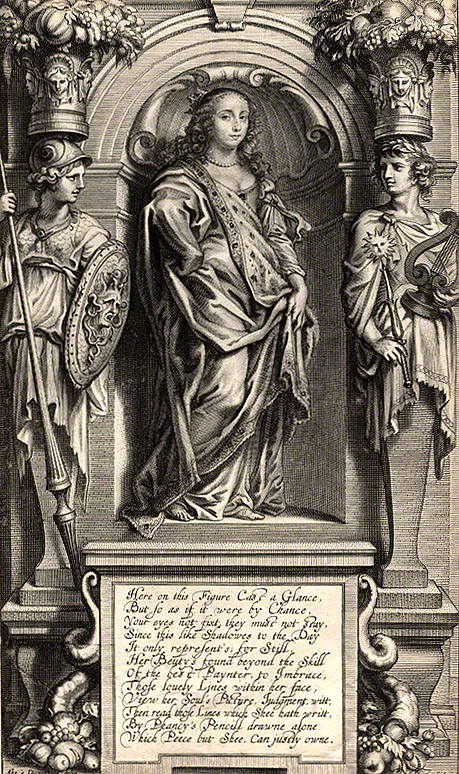
The inscription below the portrait states:
(2) Image of the Scholar portrait, courtesy of the National Portrait Gallery in London.
Another portrait is “as Scholar Marchioness: she sits by her writing table, wearing a plain dark dress, a feminine equivalent of scholar’s black, though she also wears a marchioness’s coronet, while a fine carriage clock takes the place of the hourglass used in scholars’ portraits to indicate that time is being well used. A cloth of state hangs above her, and in front of her, separating her from the viewer, is a low balustrade, such as was used to divide the monarch or aristocrat on his dais from the rest of the room.” (Stevenson, 2009, pg. 212) It is not clear who was the engraver of this image. Note: Unfortunately this portrait does not appear in any of digitized copies of Cavendish’s works available in EEBO. Perhaps it appears in different copies (research forthcoming).
Other individual portraits
The National Portrait Gallery’s website indicates that there are at least three other extant portraits, engraved after Van Diepenbeeck:
(3) Seated portrait, engraver unknown. This portrait appears in two of the works on EEBO. Courtesy of the National Portrait Gallery in London (two copies).
(4) Draped robe standing portrait, various engravers. Courtesy of the National Portrait Gallery in London (three copies).
(5) Court dress with pillar standing portrait, by William Greatbach, after Abraham Diepenbeeck. Courtesy of the National Portrait Gallery in London (two copies.)
Van Diepenbeeck – family portraits
There are also four group family portraits engraved after drawings by Van Diepenbeeck, some of which also serve as frontispieces. Courtesy of the National Portrait Gallery in London.
(6) The Duke and his family, by Peter van Lisebetten (Lysebetten, Liesebetten), after Abraham Diepenbeeck.
(7) William & Margaret Cavendish seated, by Peter van Lisebetten (Lysebetten, Liesebetten), after Abraham Diepenbeeck.
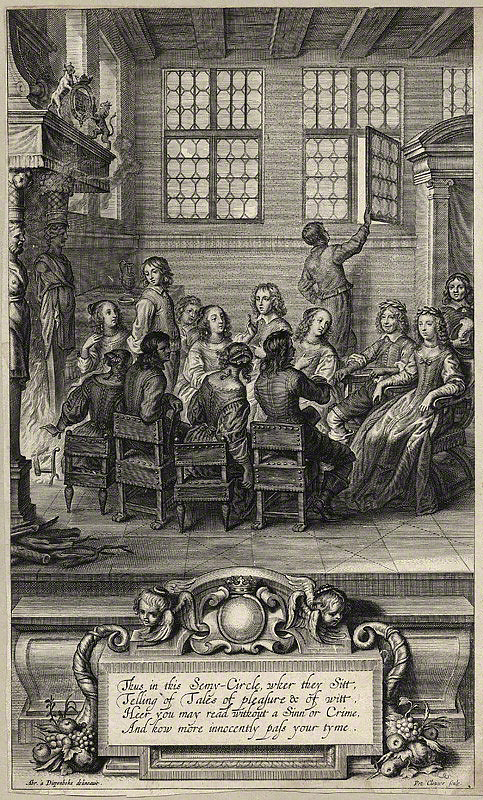
(8) The Duke and his family in Antwerp, by Peeter Clouwet, after Abraham Diepenbeeck. This portrait appears once in Cavendish’s works in EEBO.
The inscription below the picture states:
(9) William & Margaret Cavendish, small seated picture, by James Mitan, after Peeter Clouwet.
Painted portraits
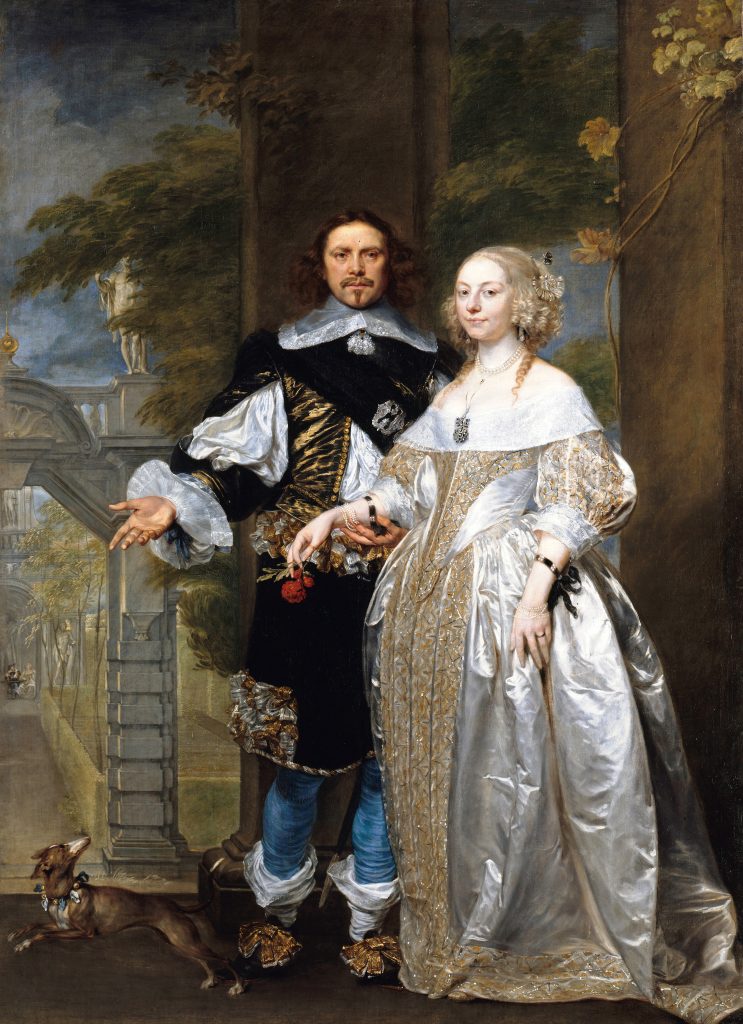
The portrait on our website is by Gonzales Coques, and is called “Portrait of a Married Couple in a Park,” or “Lord Cavendish und Seine Frau Margaret im Rubensgarten in Antwerpen” (Kat.Nr. 858). The image is reproduced here with the permission of the Staatliche Museen zu Berlin, Gemäldegalerie. Foto: Jörg P. Anders.
To date, we have been able to identify two additional possible painted portraits. One is attributed to Sir Peter Lely, but many scholars suggest that this is a painting of Cavendish’s oldest sister. Another one is attributed to Van Diepenbeeck, and was reproduced in Grant’s (1957) biography by the permission of the Duke of Portland, K.G.
List of portraits & frontispieces in Early English Books Online
Note: the following information is from digitized copies of originals available in the Early English Books Online proprietary database. First editions are in bold. There may be other copies of Cavendish’s work with different portraits or frontispieces.
Spreadsheet version of table: Excel file
|
Source |
Year |
Portrait |
Frontispiece |
Source library |
|---|---|---|---|---|
|
Philosophical Fancies |
1653
|
— |
London. Printed by Tho. Roycroft for J. Martin and J. Allestrye at the Bell in Saint Pauls Church-yard. |
British Library |
|
Poems and Fancies |
1653
|
Minerva & Apollo (1)
|
London. Printed by T. R. for J. Martin and J. Allestrye at the Bell in Saint Pauls Church Yard. |
Huntington Library |
|
Philosophical and Physical Opinions
|
1655 |
Grant (1957) cites Scholar portrait (2) but this is not in EEBO.
|
London. Printed for J. Martin and J. Allestrye at the Bell in Saint Pauls Church-Yard. |
British Library |
|
The World’s Olio |
1655 |
Minerva & Apollo (1)
|
London. Printed for J. Martin and J. Allestrye at the Bell in Saint Pauls Church-Yard. |
Huntington Library |
|
Nature’s Pictures |
1656
|
Duke and his family in Antwerp (8)
|
London. Printed for J. Martin and J. Allestrye at the Bell in Saint Pauls Church-Yard. |
Huntington Library |
|
Orations of Divers Sorts
|
1662 |
— |
London. Printed Anno Dom. (1663 in Latin) |
Cambridge University |
|
Plays |
1662
|
Minerva & Apollo (1)
|
London. Printed by A. Warren for John Martyn, James Allestry, and Tho. Dicas, at the Bell in Saint Pauls Church Yard. |
Huntington Library |
|
Orations of Divers Sorts
|
1663 |
— |
London. Printed Anno Dom. 1663. |
University of Durham, England |
|
Philosophical and Physical Opinions
|
1663 |
— |
London: Printed by William Wilson. |
Huntington Library |
|
Sociable Letters |
1664
|
— |
London: Printed by William Wilson. |
Harvard University Library |
|
Philosophical Letters |
1664
|
— |
London. Printed in the year 1664. |
Cambridge University Library |
|
Poems and Fancies
|
1664 |
— |
London: Printed by William Wilson. Anno Dom. (1664 in Latin) |
Huntington Library |
|
Observations upon Experimental Philosophy & The Blazing World |
1666 |
— |
London: Printed by A. Maxwell, in the Year 1666. |
University of Illinois (Urbana-Champaign Campus) |
|
The Blazing World |
1666 |
— |
London: Printed by A. Maxwell, in the Year 1666. |
Harvard University Library |
|
The Life of William |
1667 |
— |
London: Printed by A. Maxwell, in the Year 1667. |
University of Illinois (Urbana-Champaign Campus) |
|
The Blazing World
|
1668 |
Seated portrait (3) |
London: Printed by A. Maxwell, in the Year (1668 in Latin.) |
British Library |
|
Grounds of Natural Philosophy (revised 3rdedition of Philosophical and Physical Opinions) |
1668 |
Image not available in EEBO. |
Image not available in EEBO. |
Huntington Library |
|
Observations upon Experimental Philosophy & The Blazing World |
1668 |
— |
London: Printed by A. Maxwell, in the Year 1668. |
Cambridge University Library |
|
The Blazing World |
1668 |
Seated portrait (3) |
London: Printed by A. Maxwell, in the Year (1668 in Latin.) |
British Library |
|
Orations of Divers Sorts
|
1668 |
— |
London: Printed by A. Maxwell, in the Year 1668. |
Edinburgh University Library |
|
Plays, Never Before Printed
|
1668
|
Minerva & Apollo (1)
|
London: Printed by A. Maxwell, in the Year (1668 in Latin.) |
Huntington Library |
|
Poems and Fancies, or Several Fancies In Verse
|
1668 |
Minerva & Apollo (1) Court dress (5)
|
London: Printed by A. Maxwell, in the Year 1668. |
Huntington Library |
|
Nature’s Pictures
|
1671 |
Minerva & Apollo (1)
|
London: Printed by A. Maxwell, in the Year 1671. |
British Library |
|
The World’s Olio
|
1671 |
— |
London: Printed by A. Maxwell, in the Year 1671. |
Huntington Library |
|
The Life of William
|
1675 |
Portrait of William. |
London: Printed by A. Maxwell, in the Year 1675. |
Huntington Library |
National Portrait Gallery, London
The National Portrait Gallery main link for Van Diepenbeeck’s portraits of Cavendish.
References
Grant, Douglas. 1957. Margaret the First; a biography of Margaret Cavendish, Duchess of Newcastle, 1623-1673: London, Hart-Davis, 1957. (See illustrations page in front matter.)
Steadman, David W. 1982. Abraham Van Diepenbeeck: Seventeenth Century Flemish Painter. Ann Arbor, MI: UMI Research Press.
Stevenson, Jane. 2009. “Women and the Cultural Politics of Printing.” The Seventeenth Century 24 (2): 205-237.
For image sources and permissions see our image gallery.
1.3 Chronology
Source: For more details, see the very helpful account of the major dates and events in Cavendish’s life in O’Neill, Eileen, editor, 2001. Margaret Cavendish: Observations upon Experimental Philosophy. Cambridge: Cambridge University Press, pp. xxxvii-xli.
| Year | Event |
|---|---|
| c. 1623 | Margaret Lucas, youngest of eight children of Thomas Lucas and Elizabeth Leighton Lucas, born in Colchester, England. |
| 1625 | Death of Cavendish’s father, Thomas. |
| 1630 | Hobbes begins teaching natural philosophy to William Cavendish, Earl of Newcastle, and to William’s brother, Charles. |
| 1635-36 | Hobbes joins Marin Mersenne’s scholarly circle in Paris, which maintained contact with Descartes. |
| 1641 | Descartes’s Meditations on First Philosophy published in Latin. |
| 1642 | Looters enter Cavendish’s home in St. John’s Abbey as the English Civil War begins. |
| 1643 | Cavendish becomes a maid of honor to Queen Henrietta Maria, who had fled from anti-Royalist forces in London to Merton College in Oxford.
Princess Elisabeth of Bohemia enters into a now famous correspondence with Descartes, challenging his dualism of mind and body. |
| 1644 | Descartes’s Principles of Philosophy, Mersenne’s Synopsis of Universal Geometry and Mixed Mathematics and Physico-Mathematical Thoughts, and Kenelm Digby’s Two Treatises, are all published. Descartes’s Principles would be seen as his magnum opus in natural philosophy, and was translated into French three years later. Cavendish follows Queen Henrietta Maria into exile in Paris. |
| 1645 | Cavendish’s future husband William travels in the Netherlands and visits the exiled Queen Elizabeth of Bohemia in The Hague; he later arrives in Paris, where he meets and corresponds with Cavendish. William and Margaret marry at year’s end in Sir Richard Browne’s chapel, thereby changing Margaret’s life forever. |
| 1647 | Death of Cavendish’s sister, Mary Killigrew; her mother, Elizabeth Leighton Lucas; and her illegitimate brother, Sir Thomas. |
| 1648 | Mersenne dies. Cavendish and her husband William travel to Holland following King Charles I, and rent the house formerly owned by the famous painter, Peter Paul Rubens, in Antwerp. Parliamentary troops execute Margaret Cavendish’s brother, Sir Charles. |
| 1649 | King Charles I is executed in London. |
| 1650 | During his time in Stockholm tutoring Queen Christina, who would later become an important figure for thinkers like Émilie Du Châtelet, Descartes dies. Hobbes publishes his The Elements of Law, Natural and Politic.
Walter Charleton publishes some medical treatises of J. B. Van Helmont, in his A Ternary of Paradoxes. |
| 1651 | Hobbes publishes what would become his most famous and influential work, Leviathan. |
| 1652 | Walter Charleton publishes his The Darknes of Atheism Dispelled by the Light of Nature. |
| 1653 | Henry More’s An Antidote Against Atheisme and the first English edition of William Harvey’s On the Motion of the Heart and Blood in Animals are both published.
Cavendish publishes her very first volume, Poems, and Fancies, followed quickly by Philosophicall Fancies a few months later. She returns from her trip to England back to Antwerp. |
| 1654 | Charleton’s Physiologia-Epicuro-Gassendo-Charltoniana is published, an influential work that would be read by many natural philosophers, including a young Isaac Newton.Death of Charles Cavendish. |
| 1655 | Cavendish’s shorter literary pieces, including Shakespeare criticism and her discussion of Harvey on the circulation of the blood, are published as The World’s Olio.Also published are Cavendish’s Philosophical and Physical Opinions, and Hobbes’ Latin treatise, Elements of Philosophy, The First Section Concerning Body, which was published in an English translation in 1656.
Death of Pierre Gassendi. |
| 1656 | Cavendish publishes Nature’s Pictures, which includes her biographical essay ‘‘A True Relation of My Birth, Breeding and Life.” |
| 1657 | Cavendish corresponds with Constantijn Huygens, father of the mathematician and philosopher Christiaan, who would become renown throughout Europe later in the century. |
| 1658 | William Cavendish publishes a French work, The New Method and Extraordinary Invention to Dress Horses and Work Them According to Nature. |
| 1659 | Henry More publishes The Immortality of the Soul; More would eventually become connected with the philosopher Anne Conway. |
| 1660 | Charles II is restored to the throne.Cavendish and her husband William return from exile, residing at Welbeck Abbey, an estate in Nottingham. She becomes an honorary member of the literary salon of Katherine Philips. Robert Boyle publishes his famous New Experiments Physico-Mechanicall, touching the Spring of the Air and Its Effects; we have reproduced a diagram from this work in the Images section of the site. |
| 1662 | Cavendish’s Playes and Orations of Divers Sorts, as well as Johannes Baptista Van Helmont’s Oriatrike, Or, Physick Refined are published. |
| 1663 | A revised version of Cavendish’s Philosophical and Physical Opinions and Henry Power’s Experimental Philosophy are both published. |
| 1664 | Henry More discusses Cavendish in his letter of March 1664/65 to Conway. |
| 1665 | Robert Hooke, a former assistant to Boyle and later the Curator of Experiments at the Royal Society, publishes his Micrographia, which is often considered a neglected work of this period.
William Cavendish is made Duke of Newcastle. |
| 1666 | Cavendish publishes her Observations upon Experimental Philosophy, to which is added, the Description of a New Blazing World.Margaret Cavendish’s eldest brother, John, is expelled from the Royal Society of London |
| 1667 | Cavendish’s The Life of the Thrice Noble . . . William Cavendishe is published, with a Latin translation published by Walter Charleton in 1668.Cavendish corresponds with Glanvill on metaphysical issues and also visits the Royal Society of London. |
| 1668 | Cavendish’s Grounds of Natural Philosophy and Plays, never before Printed are both published |
| 1673 | Cavendish dies on December 15 – she is buried in Westminster Abbey on January 7 of the next year. |
| 1676 | William Cavendish edits and publishes Letters and Poems in Honour of the Incomparable Princess, Margaret, Dutchess of Newcastle.Death of William – he is buried next to Margaret in Westminster Abbey. |
2. Primary Sources Guide
Cavendish delighted in publicizing her work: unlike her fellow English philosophers Conway and Masham, she insisted on having her name, and usually a portrait, printed in her works. Given that she was a prolific writer, we have tried to breakdown the information on primary sources in a helpful way. Section 2.1 provides a chronological reference list of Cavendish’s published works, a breakdown of the references according to specific work and its editions, and a list of modern editions. Section 2.2 provides a brief description of each of her works.
There is no standard critical edition of Cavendish’s complete works, and few of her writings are available in their entirety in modern editions. However, digital scans of the originals of all her works are available electronically through the Early English Books Online (proprietary) database. It also makes available modern text transcriptions of all the first editions of the texts.
An annotated list of Cavendish’s texts, printers, and booksellers (1653-1675) has been compiled by Cameron Kroetsch and is available for download as a PDF on the Digital Cavendish Project website.
Spreadsheet overview: Excel file
2.1 Primary Sources
Chronological list
Cavendish, Margaret. 1653. Philosophicall Fancies. London: Printed by Tho. Roycroft for J. Martin and J. Allestrye.
______. 1653. Poems and Fancies. London: Printed by T. Roycroft for J. Martin and J. Allestrye at the Bell in Saint Pauls Church Yard.
______. 1655. Philosophical and Physical Opinions. London: Printed for J. Martin and J. Allestrye at the Bell in St. Pauls Church-Yard.
______. 1655. The World’s Olio. London: Printed for J. Martin and J. Allestrye.
______. 1656. Nature’s Pictures Drawn by Fancie’s Pencil to Life. London: Printed for J. Martin and J. Allestrye at the Bell in Saint Paul’s Church-yard.
______. 1662. Orations of Divers Sorts, Accommodated to Divers Places. London: Printed by William Wilson.
______. 1662. Playes. London: Printed by A. Warren for John Martyn, James Allestry, and Tho. Dicas, at the Bell in Saint Pauls Church Yard.
______. 1663. Orations of Divers Sorts, Accommodated to Divers Places. London: Printed by William Wilson.
______. 1663. Philosophical and Physical Opinions. London: Printed by William Wilson.
______. 1664. CCXI Sociable Letters. London: Printed by William Wilson.
______. 1664. Philosophical Letters. London: Publisher unknown.
______. 1664. Poems and Fancies. London: Printed by William Wilson.
______. 1666. The Description of a New World, Called the Blazing World. London: Printed by A. Maxwell.
______. 1666. Observations upon Experimental Philosophy. To Which is Added, the Description of a New Blazing World. London: Printed by A. Maxwell.
______. 1667. The Life of the Thrice Noble, High and Puissant Prince William Cavendishe, Duke, Marquess, and Earl of Newcastle. London: Printed by A. Maxwell.
______. 1668. The Description of a New World, Called the Blazing World. London: Printed by A. Maxwell.
______. 1668. Grounds of Natural Philosophy. London: Printed by A. Maxwell.
______. 1668. Observations upon Experimental Philosophy. To Which is Added, the Description of a New Blazing World. 2nd ed. London: Printed by A. Maxwell.
______. 1668. Orations of Divers Sorts, Accommodated to Divers Places. London: Printed by A. Maxwell.
______. 1668. Playes, Never Before Printed. London: Printed by A. Maxwell.
______. 1668. Poems, or Several Fancies in Verse: with the Animal Parliament, in Prose… The Third Edition. London: Printed by A. Maxwell.
______. 1671. Nature’s Pictures Drawn by Fancie’s Pencil to Life. London: Printed by A. Maxwell.
______. 1671. The World’s Olio. London: Printed by A. Maxwell.
______. 1675. The Life of the Thrice Noble, High and Puissant Prince William Cavendishe, Duke, Marquess, and Earl of Newcastle. London: Printed by A. Maxwell.
Contemporary Latin edition of the Life of William
Charleton, William, ed. 1668. De Vita et Rebus Gestis…Guilielmi Ducis Novo-Castrensis. London: Printed by T. Milbourne.
Contemporary review of Cavendish’s work
Du Verger, S. 1657. Humble Reflections upon some passages of the Right Honorable the Lady Marchionesse of Newcastles Olio, or, An Appeale from her Mes-informed, to her Owne Better Informed Judgement. Printed at London: Publisher unknown.
Early English Books Online database, Gale Group, has a modern text transcript and images of the 1657 original in the Huntington Library.
O’Neill cites this work as the only published contemporary critical response. Reference: O’Neill, Eileen. 2001. Margaret Cavendish: Observations upon Experimental Philosophy. Cambridge: Cambridge University Press.
List of editions, by work in alphabetical order
Blazing World
Cavendish, Margaret. 1666. The Description of a New World, Called the Blazing World. London: Printed by A. Maxwell.
______. 1668. The Description of a New World, Called the Blazing World. London: Printed by A. Maxwell.
The Life of William
Cavendish, Margaret. 1667. The Life of the Thrice Noble, High and Puissant Prince William Cavendishe, Duke, Marquess, and Earl of Newcastle. London: Printed by A. Maxwell.
Charleton, William, ed. 1668. De Vita et Rebus Gestis…Guilielmi Ducis Novo-Castrensis. London: Printed by T. Milbourne.
Cavendish, Margaret. 1675. The Life of the Thrice Noble, High and Puissant Prince William Cavendishe, Duke, Marquess, and Earl of Newcastle. London: Printed by A. Maxwell.
Philosophical Fancies
Cavendish, Margaret. 1653. Philosophicall Fancies. London: Printed by Tho. Roycroft for J. Martin and J. Allestrye.
Philosophical and Physical Opinions (later renamed Grounds of Natural Philosophy)
Cavendish, Margaret. 1655. Philosophical and Physical Opinions. London: Printed for J. Martin and J. Allestrye at the Bell in St. Pauls Church-Yard.
______. 1663. Philosophical and Physical Opinions. London: Printed by William Wilson.
______. 1668. Grounds of Natural Philosophy. London: Printed by A. Maxwell.
Plays & Plays Never Before Printed
Cavendish, Margaret. 1662. Playes. London: Printed by A. Warren for John Martyn, James Allestry, and Tho. Dicas, at the Bell in Saint Pauls Church Yard.
______. 1668. Playes, Never Before Printed London: Printed by A. Maxwell.
Poems and Fancies
Cavendish, Margaret. 1653. Poems and Fancies. London: Printed by T. Roycroft for J. Martin and J. Allestrye at the Bell in Saint Pauls Church Yard.
______. 1664. Poems and Fancies. London: Printed by William Wilson.
______. 1668. Poems, or Several Fancies in Verse: with the Animal Parliament, in Prose…The Third Edition. London: Printed by A. Maxwell.
Nature’s Pictures
Cavendish, Margaret. 1656. Nature’s Pictures Drawn by Fancie’s Pencil to Life. London: Printed for J. Martin and J. Allestrye at the Bell in Saint Paul’s Church-yard.
______. 1671. Nature’s Pictures Drawn by Fancie’s Pencil to Life. London: Printed by A. Maxwell.
Observations Upon Experimental Philosophy
Cavendish, Margaret. 1666. Observations upon Experimental Philosophy. To Which is Added, the Description of a New Blazing World. London: Printed by A. Maxwell.
______. 1668. Observations upon Experimental Philosophy. To Which is Added, the Description of a New Blazing World. 2nd ed. London: Printed by A. Maxwell.
Orations of Divers Sorts
Cavendish, Margaret. 1662. Orations of Divers Sorts, Accommodated to Divers Places. London: Printed by William Wilson.
______. 1663. Orations of Divers Sorts, Accommodated to Divers Places. London: Printed by William Wilson.
______. 1668. Orations of Divers Sorts, Accommodated to Divers Places. London: Printed by A. Maxwell.
Philosophical Letters
Cavendish, Margaret. 1664. Philosophical Letters. London: Publisher unknown.
Sociable Letters
Cavendish, Margaret. 1664. CCXI Sociable Letters. London: Printed by William Wilson.
The World’s Olio
Cavendish, Margaret. 1655. The World’s Olio. London: Printed for J. Martin and J. Allestrye.
______. 1671. The World’s Olio. London: Printed by A. Maxwell.
Modern editions of Cavendish’s work
Please note that this list is not exhaustive. Excerpts of Cavendish’s works have been published in many modern works, especially literary anthologies. Cavendish remains a popular literary author. The following list focuses on complete modern editions of her work, along with works that include her natural philosophy.
Atherton, Margaret, ed. 1994. Women Philosophers of the Early Modern Period. Indianapolis: Hackett Publishing Company.
Note: Contains selections from Philosophical Letters.
Cavendish, Margaret. 1969. CCXI Sociable Letters (Facsimile Reprint). Menston: Scolar Press.
______. 1972. Poems and Fancies (Facsimile Reprint). Menston: Scolar Press.
De Longueville, Thomas, ed. 1910. The first Duke and Duchess of Newcastle-upon-Tyne. London; New York: Longmans, Green.
Firth, C. H., ed. 1886. The Life of William Cavendish, Duke of Newcastle, to Which is Added the True Relation of my Birth, Breeding and Life. London: New York: Scribner & Wellford.
______, ed. 1903. The Cavalier in Exile; Being the Lives of the First Duke & Dutchess of Newcastle . London: G. Routledge & sons limited.
______, ed. 1906. The Life of William Cavendish, Duke of Newcastle, to Which is Added the True Relation of my Birth, Breeding and Life . London: G. Routledge.
______, ed. 1915. The Life of the First Duke of Newcastle: and other writings. London: G. Routledge.
Fitzmaurice, James, ed. 1997. Margaret Cavendish: Sociable Letters . New York: Garland.
James, Susan, ed. 2003. Margaret Cavendish: Political Writings. Cambridge: Cambridge University Press.
Lilley, Kate, ed. 1923. The Description of a New World, Called the Blazing World and Other Writings. New York: New York University Press.
______, ed. 1992. The Description of a New World, Called the Blazing World and Other Writings. New York: New York University Press.
______, ed. 1994. The Blazing World and Other Writings. London: Penguin.
Lower, Mark Antony, ed. 1872. The Lives of William Cavendish, Duke of Newcastle, and of his Wife, Margaret, Duchess of Newcastle. London: J. R. Smith.
Michael, Colette V. , ed. 1996. Grounds of Natural Philosophy (Facsimile Reprint). West Cornwall, CT: Locust Hill Press.
O’Neill, Eileen, ed. 2001. Observations Upon Experimental Philosophy. Cambridge: Cambridge University Press.
Rhys, Ernest, ed. 1915. The Life of the Duke of Newcastle. London; New York: J.M. Dent; E.P. Dutton.
______, ed. 1916. The Life of the (1st) Duke of Newcastle, & Other Writings. London; Toronto; New York: J.M. Dent & Sons, Ltd.; E.P. Dutton & Co.
Shaver, Anne, ed. 1999. The Convent of Pleasure and Other Plays. Baltimore: John Hopkins University Press.
2.2. Primary Sources Description
Cavendish was a prolific writer, composing thirteen works of varied genre, including poems, plays, fiction, orations, letters and philosophical essays. It can be a challenge to keep track of the different works, editions, and their content. Below is an overview of the content of her works. Since scholars differ in their interpretations of the works – for example, there is not a consensus on exactly which ones contain her “natural philosophy” – the descriptions are brief. The overview table in this section lists the first editions, and subsequent editions only where a work underwent major revision.
Helpful resources regarding Cavendish’s specific works include:
Stewart Duncan’s overview of the Philosophical Letters (1664)
Table of contents and sources link.
Cross-listed at The Digital Cavendish Project.
A handful of the letters are reproduced online here.
Emory Women Writers Resource Project digital edition of the atomic poems included in the first fifty or so pages of Poems and Fancies (1653):
Digital edition can be found here.
Critical introduction to digital edition can be found here.
‘The Language of Genres’ data analysis of Cavendish’s texts by Jacob Tootalian, PhD candidate in English at the University of Wisconsin-Madison, can be found on the Digital Cavendish Project website.
Articles which summarize the content of Cavendish’s works on natural philosophy:
Boyle, Deborah. 2004. “Margaret Cavendish’s Nonfeminist Natural Philosophy.” Configurations: A Journal of Literature, Science, and Technology 12 (2): 195-227.
James, Susan, ed. 2003. Margaret Cavendish: Political Writings. Cambridge: Cambridge University Press. (A critical edition of The Blazing World and Orations.)
Descriptions of Cavendish’s works
|
Source |
Year |
Brief description |
|---|---|---|
| Poems and Fancies | 1653
|
A collection of poems, epistles and some prose on a variety of topics. It is notable because the first fifty pages contain poems on atoms, and offer atomistic explanations of various natural phenomena such as cold, life, death, frost, etc. Various other topics include animals, the sun, roaring of the sea, witches of Lapland, battle between life and death, love, passions, etc.
Emory Women Writers Resource Project digital edition of the atomic poems. |
| Philosophical Fancies | 1653
|
A collection of short thoughts and verse on natural and other topics such as: matter, nature, infinite knowledge, vacuum, division, pleasure, senses, thinking, animals, optics, planets, etc. |
| The World’s Olio
|
1655 | Note: the term ‘olio’ means a ‘miscellaneous collection of things.’
A collection of short essays on a variety of social topics such as fame, why men write books, translating, languages, music, dancing, virtues and vices, mind and body, riches and poverty, etc. It contains references to various historical and mythological figures. |
| Philosophical and Physical Opinions
|
1655 | Offers explanations of various natural phenomena such as life, death, growth, passions, light, earth, water, air, fire, and diseases, in terms of motion as well as in non-mechanistic terms. The work also discusses variety in nature and the possibility of our knowledge of nature. The front matters includes the Condemning Treatise of Atomes, which is sometimes interpreted as a rejection her earlier atomistic views. |
| Nature’s Pictures
|
1656
|
A collection of stories in verse, prose and dialogues mostly on the topic of love, in which Cavendish discusses the position of women in society. She also satirizes the use of tobacco. The first edition (but not the second 1671 edition) contains an autobiographical letter titled ‘A True Relation of my Birth, Breeding and Life.’ |
| Plays | 1662
|
The first collection of plays includes fourteen pieces, many of which comment on the position of women in society:
Loves Adventures The Several Wits Youths Glory, and Death’s Banquet The Lady Contemplation Wits Cabal The Unnatural Tragedy The Public Wooing The Matrimonial Trouble Nature’s Three Daughters, Beauty, Love and Wit The Religious The Comical Hash Bell in Campo A Comedy of the Apocryphal Ladies The Female Academy |
| Orations of Divers Sorts
|
1662 | A collection of oratory speeches which present multiple opposing views on subjects to do with a fictional society which is on the brink of civil war. The orations take up subjects such as the pros and cons of peace and war, the levying of taxes, theft, adultery, and virtues appropriate to private and public life. Some of the orations also explore the position of women in society, and discuss the reasons for women’s subordinate position to men, including their lack of educational opportunities. |
| Philosophical and Physical Opinions | 1663 | This is a major revision of Cavendish’s earlier work of the same title. The 1655 first edition is 174 pages, but the 1663 edition is 510 pages including the prefaces and index. To read an open access version of this text, see Margaret Cavendish: Philosophical and Physical Opinions (1663 edition), edited by Marcy Lascano. |
| Sociable Letters | 1664
|
A collection of fictional and partly auto-biographical letters between two gentlewomen. The witty letters discuss a variety of social topics from daily life, notably love and the institution of marriage. The work is often interpreted as a critique of marriage. |
| Philosophical Letters | 1664
|
The work presents Cavendish’s natural philosophy and engages with the ideas of Hobbes, Descartes, Henry More, J.B. Van Helmont, and other seventeenth-century philosophers such as Robert Boyle and William Harvey. For example, Cavendish discusses their mechanical explanations of perception, light and colors, the view that motion can be transferred, and their views on immaterial substances. She also discusses the limits of human knowledge. The work is often interpreted as a critical response to these philosophers.
Stewart Duncan’s overview of the Letters: Table of contents and sources link Cross-listed at The Digital Cavendish Project A handful of the letters are reproduced online here |
| Observations upon Experimental Philosophy
|
1666 | The work discusses the mechanical, corpuscular and experimental philosophy promoted by the Royal Society, and the use of new instruments such as microscopes and telescopes. It is often interpreted as a direct critique of the Royal Society’s work, especially Robert Hooke’s Micrographiaand Robert Boyle’s experiments. The work also discusses mechanistic explanations of natural phenomena and atomism.
Some scholars suggest that the Observations and The Blazing World, which were initially published together, should be viewed as philosophical companion pieces despite their different genres. |
| The Blazing World
(published with Observations)
|
1666
|
A fictional sci-fi utopia, which tells a story of a woman who is abducted from her world and becomes the Empress of a different world, where she proceeds to set up learned societies, study immaterial spirits, and wage futuristic-style warfare back in her own world. The Duchess of Newcastle acts as an adviser to the Empress. The work is considered a forerunner of science fiction, and is often interpreted as a satire of the Royal Society and the irrelevance of its methods for effective political governance. |
| The Life of William
|
1667 | A biography of her husband, William Cavendish, the first Duke of Newcastle. The biography became very popular and was reprinted several times. |
| Plays, Never Before Printed
|
1668
|
The second collection of plays consists of six new pieces. Like her first collection of plays, the second set comments on women’s’ position in society. Many of them also poke fun at the dashing ‘rake’ lover ideal of the Restoration period.
The Sociable Companions, or the Female Wits The Presence Scenes (edited from The Presence) The Bridals The Convent of Pleasure A Piece of a Play |
| Grounds of Natural Philosophy
(3rd edition of Philosophical and Physical Opinions)
|
1668 | A revised second edition of Philosophical and Physical Opinions. The work, split into thirteen sections, presents Cavendish’s view on natural philosophy and its implications for a variety of natural phenomena, such as perception, animal and human reproduction, appetites and passions, human dreams, illness, etc. It also discusses natural phenomena such as fire, tides, wind, the motions of the planets, etc.
The work includes five appendices on the topics of immaterial spirits, possibility of other worlds, happiness of creatures, natural conditions in an irregular world, and the possibility of resurrection by means of restoring beds or ‘wombs.’ |
3. Secondary Sources Guide
The following reference list focuses on scholarship that is most relevant to philosophy. The list is by no means exhaustive, as Cavendish is a very popular figure in many humanistic disciplines and the scholarly literature is vast. A critical treatise of Cavendish’s philosophy from an analytic philosophy perspective has not yet been published, although new scholarship is forthcoming.
Bibliographies
For extensive bibliographies categorized according to topic, please consult the following resources:
James, Susan, ed. 2003. Margaret Cavendish: Political Writings. Cambridge: Cambridge Univ Press. (See pp. xxxiv-xxxix of the Introduction)
O’Neill, Eileen. 2001. Margaret Cavendish: Observations upon Experimental Philosophy. Cambridge: Cambridge University Press. (See Further Reading, pp. xlii-xliv.)
Weise, Wendy. 2012. “Recent Studies in Margaret Cavendish, Duchess of Newcastle (2001-2010).” English Literary Renaissance 42 (1): 146-176.
The Margaret Cavendish Bibliography Initiative of the International Margaret Cavendish Society, maintained by graduates at Brigham Young University since 2012.
Introductory resources
Some introductory resources for students and instructors who are just starting to explore Cavendish’s natural and political philosophy are:
Chapter in Jacqueline Broad’s Women Philosophers of the Seventeenth Century (2002)
David Cunning’s article in the Stanford Encyclopedia of Philosophy
Introduction by Susan James to her edition of Margaret Cavendish: Political Writings (2003)
Introduction by Eileen O’Neill to her edition of Observations Upon Experimental Philosophy (2001)
Lisa Sarasohn’s book The Natural Philosophy of Margaret Cavendish: Reason and Fancy During the Scientific Revolution (2010)
Edited collections
Two recent edited collections include essays on various aspects of Cavendish’s life and work, including her natural philosophy:
Stephen Clucas, A Princely Brave Woman: Essays on Margaret Cavendish, Duchess of Newcastle(2003)
Sara Mendelson, Margaret Cavendish (2009)
3.1 Secondary Sources
Selected reference works & encyclopedia articles
Knight, Joseph. 1917. “Cavendish, Margaret.” In The Dictionary of National Biography, Vol. 3, edited by Leslie Stephen and Sidney Lee. Oxford: Oxford University Press.
O’Neill, Eileen. “Cavendish, Margaret Lucas (1623-1673).” In Routledge Encyclopedia of Philosophy, Vol. 1, edited by E. Craig.
Schiebinger, Londa. 1987. “Margaret Cavendish, Duchess of Newcastle: Natural Philosopher (1617-1673).” Resources for Feminist Research 16 (3).
______. 1991. “Margaret Cavendish, Duchess of Newcastle.” In Modern Women philosophers, 1600-1900, Vol. 3, edited by Mary Ellen Waithe. Dordrecht: Kluwer.
Selected secondary sources in philosophy
Adams, Marcus P. 2016. “Visual Perception as Patterning: Cavendish against Hobbes on Sensation.” History of Philosophy Quarterly 33.3 (July 2016): 193–214.
Alic, Margaret. 1986. “The Rise of the Scientific Lady.” In Hypatia’s Heritage: a History of Women in Science from Antiquity Through the Nineteenth Century, edited by Margaret Alic. Boston: Beacon Press.
Ankers, Neil. 2000. “Margaret Cavendish and the Nature of the Individual.” In-between: Essays and Studies in Literary Criticism 9 (1-2): 301-315.
______. 2003. “Paradigms and Politics: Hobbes and Cavendish Contrasted ” In A Princely Brave Woman: Essays on Margaret Cavendish, edited by Stephen Clucas. Aldershot: Ashgate.
Apostalova, Iva. 2010. “Princess Elizabeth of Bohemia and Margaret Cavendish: The Feminine Touch in Seventeenth-Century Epistemology.” Maritain Studies/Etudes Maritainiennes 26: 83-97.
Barnes, Diana. 2009. “Familiar Epistolary Philosophy: Margaret Cavendish’s Philosophical Letters (1664).” Parergon: Journal of the Australian and New Zealand Association for Medieval and Early Modern Studies 26 (2): 39-64.
Battigelli, Anna. 1998. Margaret Cavendish and the Exiles of the Mind, Studies in the English Renaissance. Lexington, KY: University Press of Kentucky.
______. 1998. “Political thought/political action: Margaret Cavendish’s Hobbesian dilemma.” In Women Writers and the Early Modern British Political Tradition, edited by Hilda L. Smith and Carole Pateman. Cambridge, England: Cambridge University Press.
Bergès, Sandrine. 2018. “Lucretia and the Impossibility of Female Republicanism in Margaret Cavendish’s Sociable Letters.” Hypatia 33.4 (2018): 663–680.
Bertuol, Roberto. 2001. “The Square Circle of Margaret Cavendish: the 17th Century Conceptualization of Mind by Means of Mathematics.” Language and Literature 10 (1): 21-39.
Blaydes, Sophia B. 1988. “Nature Is a Woman: The Duchess of Newcastle and Seventeenth-Century Philosophy.” In Man, God, and Nature in the Enlightenment, edited by Donald C. Mell, Jr., Theodore E. D. Braun and Lucia M. Palmer. East Lansing, MI: Colleagues.
Bordo, Susan. 1999. “Women Cartesians, ‘Feminine Philosophy,’ and Historical Exclusion.” In Feminist Interpretations of René Descartes, edited by Susan Bordo. University Park, PA: Pennsylvania State University Press.
Borlik, Todd. 2008. “The Whale under the Microscope: Technology and Objectivity in Two Renaissance Utopias.” In Philosophies of Technology: Francis Bacon and His Contemporaries, edited by Claus Zittel, Gisela Engel, Romano Nanni and Nicole C. Karafyllis. Leiden: Brill.
Boyle, Deborah. 2004. “Margaret Cavendish’s Nonfeminist Natural Philosophy.” Configurations: A Journal of Literature, Science, and Technology 12 (2): 195-227.
______. 2006. “Fame, Virtue, and Government: Margaret Cavendish on Ethics and Politics.” Journal of the History of Ideas 67 (2): 251-289.
______. 2013. “Margaret Cavendish.” Philosophers’ Magazine 60 (1): 63 – 65.
______. 2013. “Margaret Cavendish on Gender, Nature, and Freedom.” Hypatia: A Journal of Feminist Philosophy 28 (3): 516-532.
______. 2015. “Margaret Cavendish on Perception, Self-Knowledge, and Probable Opinion.” Philosophy Compass 10, no. 7 (2015): 438-450.
______. 2017. “Freedom and Necessity in the Work of Margaret Cavendish.” In Women and Liberty, 1600-1800: Philosophical Essays, edited by Jacqueline Broad, and Karen Detlefsen. Oxford: Oxford University Press, 2017. Oxford Scholarship Online, 2017. doi: 10.1093/oso/9780198810261.003.0010.
______. 2017. The Well-Ordered Universe the Philosophy of Margaret Cavendish. New York, NY: Oxford University Press.
______. 2019. “Informed by ‘Sense and Reason’: Margaret Cavendish’s Theorizing about Perception.” In The Senses and the History of Philosophy. Edited by Brian Glenney and José Filipe Silva, 231–248. Abingdon, UK: Routledge, 2019.
Broad, Jacqueline. 2002. Women Philosophers of the Seventeenth Century. Cambridge: Cambridge University Press.
______. 2007. “Margaret Cavendish and Joseph Glanvill: Science, Religion, and Witchcraft.” Studies in History and Philosophy of Science 38 (3): 493-505.
______. 2011. “Cavendish, Van Helmont and the Mad Raging Womb.” In The New Science and Women’s Literary Discourse: Prefiguring Frankenstein, edited by Judy A. Hayden. New York, NY: Palgrave Macmillan.
______. 2011. “Is Margaret Cavendish Worthy of Study Today?” Studies in History and Philosophy of Science 42 (3): 457-461.
______. 2012. “Impressions in the Brain: Malebranche on Women, and Women on Malebranche.” Intellectual History Review 22 (3): 373-389.
Broad, Jacqueline, and Karen Green. 2009. “Margaret Cavendish, Duchess of Newcastle.” In A History of Women’s Political Thought in Europe, 1400-1700, edited by Jacqueline Broad and Karen Green. Cambridge: Cambridge University Press.
Clairhout, Isabelle, and Sandro Jung. 2011. “Cavendish’s Body of Knowledge.” English Studies: A Journal of English Language and Literature 92 (7): 729-743.
Clucas, Stephen. 1994. “The Atomism of the Cavendish Circle: a Reappraisal.” The Seventeenth Century 9: 247–273.
______. 2000. “The Duchess and the Viscountess: Negotiations between Mechanism and Vitalism in the Natural Philosophies of Margaret Cavendish and Anne Conway.” In-between: Essays and Studies in Literary Criticism 9 (1-2): 125-136.
______, ed. 2003. A Princely Brave Woman: Essays on Margaret Cavendish, Duchess of Newcastle. Aldershot: Ashgate.
______. 2003. “Variation, Irregularity, and Probabilism: Margaret Cavendish and Natural Philosophy as Rhetoric.” In A Princely Brave Woman: Essays on Margaret Cavendish, edited by Stephen Clucas. Aldershot: Ashgate.
______. 2011. “Margaret Cavendish’s Materialist Critique of Van Helmontian Chymistry.” Ambix 58 (1): 1-12.
Correard, Nicolas. 2013. “Anti-Scientific Scepticism and Early Satires of the Royal Society: Exposing the Fictions of Experimental Science in Samuel Butler, Margaret Cavendish and Jonathon Swift (1660-1730).” Science et Esprit: Revue de philosophie et de théologie 65 (3): 325-342.
Cottegnies, Line, and Nancy Weitz, eds. 2003. Authorial conquests : essays on genre in the writings of Margaret Cavendish. Madison, NJ: Fairleigh Dickinson University Press; Associated University Presses.
Cunning, David. 2006. “Cavendish on the Intelligibility of the Prospect of Thinking Matter.” History of Philosophy Quarterly 23 (2): 117-136.
______, “Margaret Lucas Cavendish”, The Stanford Encyclopedia of Philosophy (Winter 2022 Edition), Edward N. Zalta & Uri Nodelman (eds.), URL =
Dear, Peter. 2007. “A Philosophical Duchess: Understanding Margaret Cavendish and the Royal Society.” In Science, Literature, and Rhetoric in Early Modern England, edited by Juliet Cummins and David Burchell. Aldershot, England: Ashgate.
Detlefsen, Karen. 2006. “Atomism, Monism, and Causation in the Natural Philosophy of Margaret Cavendish.” Oxford Studies in Early Modern Philosophy 3: 199-240.
______. 2007. “Reason and Freedom: Margaret Cavendish on the Order and Disorder of Nature.” Archiv für Geschichte der Philosophie 89 (2): 157-191.
______. 2009. “Margaret Cavendish on the Relation between God and World.” Philosophy Compass4 (3): 421-438.
______. 2012. “Margaret Cavendish and Thomas Hobbes on Freedom, Education, and Women.” In Feminist Interpretations of Thomas Hobbes, edited by Nancy J. Hirschmann and Joanne H. Wright. College Park: Pennsylvania State University Press.
Duncan, Stewart. 2012. “Debating Materialism: Cavendish, Hobbes, and More.” History of Philosophy Quarterly 29 (4): 391-409.
Fitzmaurice, Susan. 2003. “Margaret Cavendish, the Doctors of Physick and Advice to the Sick.” In A Princely Brave Woman: Essays on Margaret Cavendish, edited by Stephen Clucas. Aldershot: Ashgate.
Georgescu, Laura. 2020. “Self-knowledge, Perception, and Margaret Cavendish’s Metaphysics of the Individual”. Early Science and Medicine 25 (2020) 618-639.
Green, Karen, and Jacqueline Broad. 2006. “Fictions of a Feminine Philosophical Persona: Christine de Pizan, Margaret Cavendish and Philosophia Lost.” In The Philosopher in Early Modern Europe: the Nature of a Contested Identity, edited by Conal Condren, Stephen Gaukroger and Ian Hunter. Cambridge: Cambridge University Press.
Harris, Frances. 1997. “Living in the Neighbourhood of Science: Mary Evelyn, Margaret Cavendish and the Greshamites.” In Women, Science and Medicine: 1500-1700. Mothers and Sisters of the Royal Society, edited by Lynette Hunter and Sarah Hutton. Stroud: Alan Sutton.
Hutton, Sarah. 1997. “Anne Conway, Margaret Cavendish and Seventeenth Century-Scientific Thought.” In Women, Science and Medicine 1500-1700, edited by Lynette Hunter and Sarah Hutton.
______. 1997. “In dialogue with Thomas Hobbes: Margaret Cavendish’s natural philosophy.” Women’s Writing 4 (3): 421-432.
______. 2003. “Margaret Cavendish and Henry More.” In A Princely Brave Woman: Essays on Margaret Cavendish, edited by Stephen Clucas. Aldershot: Ashgate.
______. 2004. “John Finch, Thomas Hobbes and Margaret Cavendish.” In Anne Conway: a Woman Philosopher, edited by Sarah Hutton. Cambridge: Cambridge University Press.
______. 2009. “In Dialogue with Thomas Hobbes: Margaret Cavendish’s Natural Philosophy.” In Margaret Cavendish, edited by Sara H. Mendelson. Farnham: Ashgate.
______. 2013. “Women, Freedom, and Equality”. In Peter R. Anstey, The Oxford Handbook of British Philosophy in the Seventeenth Century. Oxford, England: Oxford University Press.
James, Susan. 1999. “The Philosophical Innovations of Margaret Cavendish.” British Journal for the History of Philosophy 7 (2): 219-244.
______. 2003. “Introduction.” In Margaret Cavendish: Political Writings, edited by Susan James. Cambridge: Cambridge University Press.
______. 2009. “The Philosophical Innovations of Margaret Cavendish.” In Margaret Cavendish, edited by Sara H. Mendelson. Farnham: Ashgate.
Kargon, Robert Hugh. 1966. Atomism in England from Hariot to Newton. Oxford: Clarendon Press.
Keller, Eve. 1997. “Producing Petty Gods: Margaret Cavendish’s Critique of Experimental Science.” ELH 64 (2): 447-471.
Lascano, Marcy P. 2020. “Margaret Cavendish and Early Modern Scientific Experimentalism: ‘Boys that play with watery bubbles or fling dust into each other’s eyes, or make a hobbyhorse of snow’”, In Kristen Intemann and Sharon Crasnow, The Routledge Handbook of Feminist Philosophy of Science (New York: NY): 60-77.
______. 2021. “The Power of Self-Motion in Cavendish’s Nature.” Powers, 169–88. https://doi.org/10.1093/oso/9780190925512.003.0011.
Lewis, Eric. 2001. “The Legacy of Margaret Cavendish.” Perspectives on Science: Historical, Philosophical, Social 9 (3): 341-365.
Linden, Stanton J. 2001. “Margaret Cavendish and Robert Hooke: Optics and Scientific Fantasy in The Blazing World.” In Esotérisme, Gnoses & Imaginaire Symbolique: Mélanges Offerts à Antoine Faivre, edited by Richard Caron, Joscelyn Godwin, Wouter J. Hanegraaff and Jean-Louis Vieillard-Baron. Louvain: Peeters.
Lynch, Marianne. 2008. “A Perfect Stranger: The Development of Margaret Cavendish’s Natural Philosophy.” PhD Dissertation, Concordia University, Canada.
Malcolmson, Cristina. 2013. Studies of Skin Color in the Early Royal Society: Boyle, Cavendish, Swift, Literary and Scientific Cultures of Early Modernity. Burlington: Ashgate.
McGuire, Mary Ann. 1971. “Margaret Cavendish, Duchess of Newcastle, on the Nature and Status of Women.” International Journal of Women’s Studies 1.2 (1971): 193–206.
McNulty, Michael Bennett. 2018. “Margaret Cavendish on the Order and Infinitude of Nature.” History of Philosophy Quarterly 35, no. 3 (2018): 219–40. https://doi.org/10.2307/48563633.
Mendelson, Sara Heller, ed. 2009. Margaret Cavendish. Surrey: Ashgate.
Merchant, Carolyn. 1989. The Death of Nature: Women, Ecology, and the Scientific Revolution. New York: Harper & Row.
Merrens, Rebecca. 1996. “A Nature of ‘Infinite Sense and Reason’: Margaret Cavendish’s Natural Philosophy and the ‘Noise’ of a Feminized Nature.” Women’s Studies 25 (5): 421-38.
Michaelian, Kourken. 2009. “Margaret Cavendish’s Epistemology.” British Journal for the History of Philosophy 17 (1): 31-53.
Mintz, Samuel. 1952. “The Duchess of Newcastle’s Visit to the Royal Society.” The Journal of English and German Philology 51: 168-76.
Monroy-Nasr, Zuraya. 2003. “Epistemología y Sujeto en la Filosofía Antimecanicista de Margaret Cavendish.” Revista Latinoamericana de Filosofia 29 (2): 185-198.
Nelson, Holly Faith, and Sharon Alker. 2014. “‘Perfect according to Their Kind’: Deformity, Defect, and Disease in the Natural Philosophy of Margaret Cavendish.” In The Idea of Disability in the Eighteenth Century, edited by Chris Mounsey. Lewisburg: Bucknell University Press.
O’Neill, Eileen. 2001. “Introduction.” In Margaret Cavendish: Observations upon Experimental Philosophy, edited by Eileen O’Neill. Cambridge: Cambridge University Press (2001).
______. 2013. “Margaret Cavendish, Stoic Antecedent Causes, and Early Modern Occasional Causes.” Revue Philosophique de la France et de l’Etranger 138 (3): 311-326.
Parageau, Sandrine. 2008. “The Function of Analogy in the Scientific Theories of Margaret Cavendish (1623-1673) and Anne Conway (1631-1679).” Etudes Epistémè 14: 89-104.
______. 2010. “Catching the ‘Genius of the Age’: Margaret Cavendish, Historian and Witness.” Etudes Epistémè 17: 55-67.
Parageau, Sandrine, and Line Cottegnies. 2008. “La Contribution des Femmes au Débat Philosophique en Angleterre au Milieu du XVIIe Siècle Margaret Cavendish (1623-1673), Anne Conway (1631-1679), et la Philosophie de la Nature.” PhD Dissertation, Université de la Sorbonne Nouvelle (Paris).
Peterman, Alison. 2019. “Margaret Cavendish on Motion and Mereology.” Journal of the History of Philosophy 57, no. 3: 471.
Rees, Emma L. E. 2003. Margaret Cavendish: Gender, Genre, Exile. Manchester, UK: Manchester University Press.
______. 2004. “Margaret Cavendish: Gender, Genre, Exile.” British Journal for the History of Philosophy 12 (4): 731-741.
Robinson, Leni. 2009. “A Figurative Matter: Continuities Between Margaret Cavendish’s Theory of Discourse and her Natural Philosophy.” PhD Dissertation, University of British Columbia, Canada.
Rogers, John. 1996. The Matter of Revolution: Science, Poetry, and Politics in the Age of Milton. Ithaca: Cornell University Press.
Rudan, Paola. 2011. “Il Centro Eccentrico: Le Donne, il Femminismo e il Soggetto a Sesso Unico.” Filosofia Politica 25 (3): 365-383.
Sarasohn, Lisa T. 1984. “A Science Turned Upside Down: Feminism and the Natural Philosophy of Margaret Cavendish.” Huntington Library Quarterly: A Journal for the History and Interpretation of English and American Civilization 47 (4): 289-307.
______.1999. “Margaret Cavendish and Patronage.” Endeavour 23 (3): 130-32.
______. 1999. “Thomas Hobbes and the Duke of Newcastle: A Study in the Mutuality of Patronage before the Establishment of the Royal Society.” Isis 90 (4): 715-737.
______. 2003. “Leviathan and the Lady: Cavendish’s Critique of Hobbes in the Philosophical Letters.” In Authorial Conquests: Essays on Genre in the Writings of Margaret Cavendish, edited by Line Cottegnies and Nancy Weitz. Madison: Fairleigh Dickinson University Press; Associated University Presses.
______.2009. “A Science Turned Upside Down: Feminism and the Natural Philosophy of Margaret Cavendish.” In Margaret Cavendish, edited by Sara H. Mendelson. Farnham, England: Ashgate.
______. 2010. The Natural Philosophy of Margaret Cavendish: Reason and Fancy During the Scientific Revolution. Baltimore: Johns Hopkins University Press.
______. 2011. “Margaret Cavendish, William Newcastle, and Political Marginalization.” English Studies 92 (7): 806-817.
Sarasohn, Lisa T., and Brandie R. Siegfried, eds. 2014. God and Nature in the Thought of Margaret Cavendish. Farnham: Ashgate.
Schiebinger, Londa. 1991. “Margaret Cavendish, Duchess of Newcastle.” In Modern Women philosophers, 1600-1900, Vol. 3, edited by Mary Ellen Waithe. Dordrecht: Kluwer.
Semler, L. E. 2012. “Margaret Cavendish’s Early Engagement with Descartes and Hobbes: Philosophical Revisitation and Poetic Selection.” Intellectual History Review 22 (3): 327-353.
Shaheen, Jonathan L. 2021. “The Life of the Thrice Sensitive, Rational and Wise Animate Matter: Cavendish’s Animism.” HOPOS: The Journal of the International Society for the History of Philosophy of Science 11.2 (2021): 621–641.
Sheehan, Richard Johnson, and Denise Tillery. 2001. “Margaret Cavendish, Natural Philosopher: Negotiating Between the Metaphors of the Old and New Sciences.” Eighteenth Century Women 1: 1-18.
Siegfried, Brandie R. 2003. “Anecdotal and Cabalistic Forms in Observations upon Experimental Philosophy.” In Authorial Conquests: Essays on Genre in the Writings of Margaret Cavendish, edited by Line Cottegnies and Nancy Weitz. Madison, NJ; London: Fairleigh Dickinson UP; Associated UP.
Smith, Hilda L. 1997. “‘A General War amongst the Men . . . But none amongst the Women’: Political Differences between Margaret and William Cavendish.” In Politics and the Political Imagination in Later Stuart Britain. Edited by Howard Nenner, 143–160. Rochester, NY: University of Rochester Press, 1997.
______. 2005. “The Many Representations of the Marquise Du Chatelet.” In Men, Women, and the Birthing of Modern Science, edited by Judith P Zinsser. DeKalb: Northern Illinois University Press.
______. 2005. “Margaret Cavendish and the Microscope as Play.” In Men, Women, and the Birthing of Modern Science, edited by Judith P Zinsser, pp. DeKalb: Northern Illinois University Press.
______. 2007. “Margaret Cavendish and the False Universal.” In Virtue, Liberty, and Toleration: Political Ideas of European women, 1400-1800, edited by Jacqueline Broad and Karen Green. Dordrecht: Springer.
Stevenson, Jay. 1996. “The Mechanist-Vitalist Soul of Margaret Cavendish.” Studies in English Literature, 1500-1900 36 (3): 527-543.
Strauss, Elisabeth Wilhelmine. 1993. “Organismus versus Maschine: Margaret Cavendish Kritik am Mechanistischen Naturmodell.” In Das Sichtbare Denken, Modelle and Modellhaftigkeit in der Philosophie un den Wissenschaften, edited by Jorge Mass. Amsterdam: Rodopi.
______. 1997. “Die Naturphilosophie von Margaret Cavendish (1623 – 1673) im Umfeld von Thomas Hobbes, Henry More und den Empiristen der Royal Society.” PhD dissertation, Frei Universiteit, Berlin, Germany.
______. 1999. Die Arithmetik der Leidenschaften: Margaret Cavendish’s Naturphilosophie. Stuttgart: Metzler-Verlag.
Tillery, Denise. 2003. “Margaret Cavendish as Natural Philosopher: Gender and Early Modern Science.” Interdisciplinary Science Reviews 28: 200–08.
______. 2007. “‘English Them in the Easiest Manner You Can’: Margaret Cavendish on the Discourse and Practice of Natural Philosophy.” Rhetoric Review 26 (3): 268-285.
Suzuki, Mihoko. 2022. “The Politics of the Civil Wars in Natures Pictures.” In Margaret Cavendish: An Interdisciplinary Perspective. Edited by Lisa Walters and Brandie R. Siegfried, 189–204. Cambridge, UK: Cambridge University Press, 2022.
Wallraven, Miriam. 2004. “‘My Spirits Long to Wander in the Air … ‘: Spirits and Souls in Margaret Cavendish’s Fiction between Early Modern Philosophy and Cyber Theory.” Early Modern Literary Studies: A Journal of Sixteenth- and Seventeenth-Century English Literature 14.
Wallwork, Jo. 2001. “Old Worlds and New: Margaret Cavendish’s Response to Robert Hooke’s Micrographia.” In Women Writing, 1550-1750, edited by Jo Wallwork and Paul Salzman. Bundoora, Australia: Meridian.
Walters, Lisa. 2014. Margaret Cavendish: Gender, Science and Politics. Cambridge: Cambridge University Press.
Webster, Erin. 2011. “Margaret Cavendish’s Socio-Political Interventions into Descartes’ Philosophy.” English Studies 92 (7): 711-728.
Weise, Wendy S. 2012. “Recent Studies in Margaret Cavendish, Duchess of Newcastle (2001-2010).” English Literary Renaissance 42 (1): 146-176.
West, Peter. 2022. “Margaret Cavendish on Conceivability, Possibility, and the Case of Colours.” British Journal for the History of Philosophy 30.3 (2022): 456–476.
Weststeijn, Thijs. 2008. Margaret Cavendish in de Nederlanden: Filosofie en schilderkunst in de Gouden Eeuw. Amsterdam: Amsterdam University Press.
Wilkins, Emma. 2014. “Margaret Cavendish and the Royal Society”, Notes and Records: The Royal Society Journal of the History of Science 68, no. 3 (2014): 245–260.
Wilson, Catherine. 2007. “Two Opponents of Material Atomism: Cavendish and Leibniz.” In Leibniz and the English-Speaking World, edited by P. Phemister and Stuart Brown. Dordrecht: Springer.
Wolfe, Charles. 2013. “Vitalism and the Resistance to Experimentation on Life in the Eighteenth Century.” Journal of the History of Biology 46 (2): 255-282.
Wright, Joanne H. 2006. “Reading the Private in Margaret Cavendish: Conversations in Political Thought.” In British Political Thought in History, Literature and Theory, 1500–1800. Edited by David Armitage, 212–234. Cambridge, UK: Cambridge University Press, 2006.
Selected secondary sources in Political Philosophy
Boyle, Deborah. 2006. “Fame, Virtue, and Government: Margaret Cavendish on Ethics and Politics.” Journal of the History of Ideas 67 (2): 251-289.
Broad, Jacqueline, and Karen Green, eds. 2007. Virtue, Liberty, and Toleration: Political Ideas of European Women, 1400-1800. Dordrecht: Springer.
______, eds. 2009. A History of Women’s Political Thought in Europe, 1400-1700 . Cambridge: Cambridge University Press.
Detlefsen, Karen. 2012. “Margaret Cavendish and Thomas Hobbes on Freedom, Education, and Women.” In Feminist Interpretations of Thomas Hobbes, edited by Nancy J. Hirschmann and Joanne H. Wright. College Park: Pennsylvania State University Press.
Iyengar, Sujata. 2002. “Royalist, Romancist, Racialist: Rank, Gender, and Race in the Science and Fiction of Margaret Cavendish.” ELH 69 (3): 649-672.
James, Susan. 2003. “Introduction.” In Margaret Cavendish: Political Writings, edited by Susan James. Cambridge: Cambridge University Press.
______, ed. 2003. Margaret Cavendish: Political Writings. Cambridge: Cambridge University Press.
Rogers, John. 1996. The Matter of Revolution: Science, Poetry, and Politics in the Age of Milton. Ithaca: Cornell University Press.
Rudan, Paola. 2011. “Il Centro Eccentrico: Le donne, il Femminismo e il Soggetto a Sesso Unico.” Filosofia Politica 25 (3): 365-383.
Webster, Erin. 2011. “Margaret Cavendish’s Socio-Political Interventions into Descartes’ Philosophy.” English Studies: A Journal of English Language and Literature 92 (7): 711-728.
Selected biographical studies
Ballard, George. 1775. Memoirs of Several Ladies of Great Britain: Who Have Been Celebrated for their Writings or Skill in the Learned Languages, Arts, and Sciences . London: Printed for T. Evans, in the Strand, Near York-Buildings.
Ballard, George, and Ruth Perry, eds. 1985. Memoirs of Several Ladies of Great Britain: Who Have Been Celebrated for their Writings or Skill in the Learned Languages, Arts, and Sciences. Detroit: Wayne State University Press.
Bartow, Virginia. 1957. “Philosophical Studies of the Duchess of Newcastle.” Journal of Chemical Education 34 (2): 82-87.
Beneden, Ben van, and Nora de Poorter, eds. 2006. Royalist Refugees: William and Margaret Cavendish in the Rubens House, 1648-1660 . Antwerp: Rubenshuis & Rubenianum.
Grant, Douglas. 1957. Margaret the First: Biography of Margaret Cavendish, Duchess of Newcastle, 1623-1673. London: Hart-Davis.
Jones, Kathleen. 1988. A Glorious Fame: the Life of Margaret Cavendish, Duchess of Newcastle (1623-1673). London: Bloomsbury.
Mendelson, Sara Heller. 1987. The Mental World of Stuart Women: Three Studies. Amherst, MA: University of Massachusetts Press.
De Longueville, Thomas. 1910. The First Duke and Duchess of Newcastle-upon-Tyne. By the Author of “A Life of Sir Kenelm Digby” [i.e. Thomas Longueville] … With illustrations. London: Longmans & Co.
Perry, Henry Ten Eyck. 1918. The First Duchess of Newcastle and her Husband as Figures in Literary History. Boston and London: Ginn and Company.
Trease, Geoffrey. 1979. Portrait of a Cavalier: William Cavendish, First Duke of Newcastle. New York: Taplinger.
Whitaker, Katie. 2002. Mad Madge: the Extraordinary Life of Margaret Cavendish, Duchess of Newcastle, the First Woman to Live by her Pen. New York: Basic Books.
Woolf, Virginia. 1925. “The Duchess of Newcastle.” In The Common Reader, edited by Virginia Woolf. London: L. & V. Woolf at the Hogarth Press.
4. Philosophy & Teaching
4.1 Methodology
4.1.1 Anti-Experimentalism
Cavendish famously criticized Royal Society members who centered experimentation in their study of natural philosophy. In Observations, Cavendish argues that her contemporaries should turn away from this trend and, instead, rely primarily on reason:
Although it be the mode [i.e., the fashion], yet I, for my part, shall not follow it; but leaving to our moderns, their experimental, or mode philosophy, built upon deluding art, I shall addict myself to the study of contemplative philosophy, and reason shall be my guide. Not that I despise sense, or sensitive knowledge: but, when I speak of sense, I mean the perception of our five exterior senses, helped (or rather deluded) by art, and artificial instruments… (Cavendish 1666, 99-100)
Despite the growing popularity of experimental philosophy, Cavendish says she will continue to engage in contemplative philosophy or philosophy that centers reason. Notice that Cavendish does not say we cannot trust our senses. Instead, her skepticism regards perceptions that come by way of artificial instruments. In particular, Cavendish was skeptical about the use of microscopes in experimental philosophy. She argued that microscopes could, at best, only reveal information about the exterior body of an object. They could not, as Royal Society members like Robert Hooke claimed, provide insight into the true nature, or inner workings, of a body (Hooke 1655, Preface). Cavendish argues,
For, put the case a microscope be true, concerning the magnifying of an exterior object; but yet the magnitude of the object, cannot give a true information of its interior parts, and their motions; or else great and large bodies would be interiorly known, even without microscopes. The truth is, our exterior senses can go no further than the exterior figures of creatures, and their exterior actions: but our reason may pierce deeper, and consider their inherent natures, and interior actions. And although it do sometimes err, (for there can be no perfect or universal knowledge in a finite part, concerning the infinite actions of nature) yet it may also probably guess at them, and may chance to hit the truth. (Cavendish 1666, 100)
If magnifying a body revealed information about the inner nature of that body, Cavendish says, then the interior workings of large bodies could be known by regular sight. Yet, the kind of information one acquires by use of a microscope is only information about the exteriority of a body. Boyle (2015) explains further, “Her critique of the use of observations derived from microscopes was thus not a critique of the use of sense-perceptions to learn about the world, but a specific objection to the pretensions of micrography to have revealed the natures of various objects” (Boyle 2015, 445). Microscopes are limited in this respect. Reason, on the other hand, Cavendish says, can properly consider the nature of an object. Again, this is not to say that Cavendish is a skeptic about our ability to acquire knowledge from sense perceptions. In fact, Cavendish says that reason and “regular sense”, or sense perceptions free from the corruption of artificial tools, are the grounds of all rational opinion (Cavendish 1666, 16). Cavendish is clear on the method she will adopt in her work on natural philosophy: “the best study, is rational contemplation joined with the observations of regular sense” (Cavendish 1666, 53).
Not only are microscopes unable to provide information about the nature of a body, Cavendish says, they are also “the greatest deluders” as they distort the appearance of objects (Cavendish 1666, 53). Importantly, the microscopes available during Cavendish’s time were less than perfect. A bad lens or a change in lighting could easily alter the image of the subject (see Lascano 2020 on this point). Microscopes were not reliable sources of objective observations. Cavendish concludes,
The inspection of a bee, through a microscope, will bring him no more honey; nor the inspection of a grain, more corn; neither will the inspection of dusty atoms, and reflexions of light, teach painters how to make and mix colours, although it may perhaps be an advantage to a decayed lady’s face, by placing herself in such or such a reflexion of light, where the dusty atoms may hide her wrinkles. The truth is, most of these arts are fallacies, rather than discoveries of truth; for sense deludes more than it gives a true information, and an exterior inspection through an optic glass, is so deceiving, that it cannot be relied upon: Wherefore, regular reason is the best guide to all arts, as I shall make it appear in this following treatise. (Cavendish 1666, 9)
The limitations and unreliability of artificial tools like microscopes, Cavendish says, make them useless. Cavendish promises that the remainder of the Observations will demonstrate the success of regular reason and regular sense in the study of natural philosophy. Observations is, then, an explicit response to the experimental philosophers of the Royal Society.
4.1.2 Probabilism and Accessibility
Wilkins’ (2014) “Margaret Cavendish and The Royal Society” helpfully shows that Cavendish agreed with various members of the Royal Society on, at least, two crucial points regarding method: probabilism and writing in plain language. First, Cavendish held that we cannot come to know any certain truths about Nature. Instead, we can form ‘probable opinions’. Cavendish explains, “Natural philosophy is no more but a rational inquisition into the causes of natural effects: and therefore, as we observe the effects and actions of nature, so we may probably guess at their causes and principles” (Cavendish 1666, 158). Natural philosophy, Cavendish says, involves an investigation into the likely causes of the effects we see in Nature. Cavendish writes, “we are all but guessers, yet he that brings the most probable and rational arguments, does come nearer to truth” (Cavendish 1666, 269). Wilkins shows that several members of the Royal Society, including Walter Charleton, Joseph Glanvill, and Robert Boyle, also held this view. These thinkers opposed philosophers like Descartes who believed we could come to have certain knowledge. For more on Cavendish’s probabilistic approach see, for example, Clucas (2003) “Variation, Irregularity and Probabilism: Margaret Cavendish and Natural Philosophy as Rhetoric” and Boyle (2015) “Margaret Cavendish on Perception, Self-Knowledge, and Probable Opinion”.
Wilkins (2014) also shows that many members of the Royal Society were “committed to expressing new ideas in natural philosophy in plain English to assist in their dissemination” (Wilkins 2014, 255). Likewise, Cavendish pledged to write plainly so that her work could be accessible for as many readers as possible. Throughout her work, Cavendish details her own struggles in reading natural philosophy without a formal education. She explains,
Wherefore, when I began to read the philosophical works of other authors, I was so troubled with their hard words and expressions at first, that had they not been explained to me, and had I not found out some of them by the context and connexion of the sense, I should have been far enough to seek; for their hard words did more obstruct, than instruct me… (Cavendish 1666, 11)
The technical terms and philosophical jargon used by these authors, Cavendish says, prevented her from understanding their work. Although Cavendish eventually understood some of this language, she promises her readers that she will not write in this way. Instead, she will try her best to make her ideas understood by both educated and uneducated readers. Cavendish says,
Although I do understand some of their hard expressions now, yet I shun them as much in my writings as is possible for me to do, and all this, that they may be the better understood by all, learned as well as unlearned; by those that are professed philosophers as well as by those that are none… (Cavendish 1666, 12).
In light of her own experience as a reader without a formal education, Cavendish aims to have her writing available to all readers. Wilkins (2014) shows that this ‘plain style’ approach was practiced by Royal Society members like William Petty and Robert Boyle. Cavendish’s method of natural philosophy begins with rational investigation and unadulterated observations and is delivered in plain language through various styles of writing, as we will see below.
4.2 Metaphysics
4.2.1 Infinite Nature
Cavendish was a materialist who endorsed the plenum and believed that nature was composed of infinite, continuous, self-moving, sensitive and rational matter. In saying nature is infinite, Cavendish does not mean that nature is infinite in a potential sense. Instead, she means that nature is actually infinite in her size such that she cannot be added to or lessened: “nature was infinite, and admitted of no addition nor diminution; and consequently, of no new creation nor annihilation of any part of hers” (Cavendish 1666, 36). Cavendish’s conception of infinity plays a central role in many of her arguments. For example, Cavendish appeals to the actual infinity of matter in her criticism of chemists who believed they could create entirely new materials. For Cavendish, all changes in nature come from pre-existing infinite matter: “Truly, matter being infinite, how some new material creatures could be created without some parts of this infinite matter, is not conceivable by human sense and reason; for infinite admits of no addition” (Cavendish 1666, 237). Nature, in this sense, is complete in her infinitude. Cavendish concludes,
Chemists need not think they can create anything anew; for they cannot challenge to themselves a divine power, neither can there be any such thing as a new creation in nature, no not of an atom. (Cavendish 1666, 236)
Cavendish’s view of infinite nature distinguishes her from Descartes who warned against using ‘infinite’ to describe things other than God and recommended we use ‘indefinite’ when talking about nature’s size (Descartes 1895 [1644], 202). Aware of views like Descartes’, Cavendish argues for the compatibility of infinite nature with the prominent theological commitments of the time. She writes that God, who makes all things good, made nature infinite so that she would be perfect:
the fullness and perfection of all things, would not suffer any vacuum in nature, which is a pure nothing; ‘‘vacuum’’ implies a want and imperfection of something, but all that God made by his all-powerful command, was good and perfect. (Cavendish 1666, 78)
Here, Cavendish turns the theological argument against natural infinity on its head. Instead of claiming that nature cannot be infinite because it would undermine God’s superior nature, Cavendish argues that believing nature is finite questions God’s power. God makes all things, including nature, good and perfect. If nature were finite, she would be lacking and thus, imperfect. Likewise, Cavendish argues here that vacuums cannot exist in nature because vacuums would be a ‘want’ and an ‘imperfection’ in a nature created by God who makes all things good, full, and perfect. Nature is complete for Cavendish in the sense that Nature contains all the matter that there is. Thus, Cavendish regularly describes Nature as “Only and Infinite matter” (Cavendish, 1655, 10-11).
She also argues that there are many kinds of infinities and that by calling nature infinite, she is not attributing a Godly attribute to a non-divine thing. God and nature cannot be infinite in the same way because nature is material and God is spiritual: “When I call Nature Infinite, I mean an Infinite extension of Body, containing an Infinite number of Parts; but what doth an Infinite extension of Body hinder the Infiniteness of God, as an Immaterial Spiritual being?” (Cavendish 1664, Sect I, Letter II). For Cavendish, arguments that deny nature infinitude to reserve infinity for God make the mistake of equivocation. It is not heretical to call nature infinite because its material infinitude is simply a different kind of infinity than God’s immaterial and spiritual infinitude.
Thus, for Cavendish, nature is unproblematically infinite in size: “There is first Infinite in quantity or bulk, that is such a big and great Corporeal substance, which exceeds all bounds and limits of measure, and may be called Infinite in Magnitude” (Cavendish 1664, sect I letter II). While parts of nature in the infinite plenum, for Cavendish, are “finite,” in the sense that they are “distinguished by their figures,” nature herself is “infinite in quantity or bulk,” and so, “her parts are infinite in number” (Cavendish 1666, 32). Cavendish describes the relationship between the finite and the infinite as being like a single grain of corn in an infinite pile:
Imagine an Infinite number of grains of Corn in one heap, surely if the number of Grains be Infinite, you must grant of necessity the bulk or body, which contains this infinite number of grains, to be Infinite too; to wit, Infinite in quantity, and yet you will find each Grain in it self to be Finite. (Cavendish 1664, sect I letter II)
For Cavendish, the whole of nature consists of infinite, finite parts “discerned from each other by their several Figures” like a single piece of grain in an infinite heap (Cavendish 1664, sect I letter II). While we experience finite parts like a tree or a dog in the natural world, they are only instances of nature’s infinite whole. Finite parts are inseparable from the infinite body of matter.
Additionally, Cavendish argues, nature is not only infinite in her size, but also infinite in her variety:
By the one Infinite, I understand Infinite in Quantity, which includes Infinite in Number, that is Infinite Parts; then Infinite in Quality, as Infinite degrees of Rarity, Density, Swiftness, Slowness, Hardness, Softness, &c. Infinite degrees of Motions, Infinite Creations… All which Infinites are contained in the Onely Matter as many Letters are contained in one Word, many Words in one Line, many Lines in one Book. (Cavendish 1664, sect I letter II)
Qualities and the degrees of qualities are infinite for Cavendish. For example, there are infinite degrees of the quality soft, from more to less soft. McNulty argues in “Margaret Cavendish on the Order and Infinitude of Nature” that this infinite variety creates an equilibrium as every kind is counterbalanced by an opposing kind. McNulty writes, “natural phenomena are counterbalanced by other, opposing phenomena. This balance prevents “confusions” and hence constitutes the order of nature” (McNulty 2018, 227). McNulty concludes that the infinite variety of Nature is essential to Cavendish’s account of balance and order.
Furthermore, if there is infinite matter and infinite variety, for Cavendish, then there are infinite worlds. She explains, “If that Matter, with which the World’s made,/ Be Infinite, then more Worlds may be said;/ Then Infinites of Worlds may we agree,/ As well, as Infinites of Matters bee” (Cavendish 1653, 30). Cavendish is not making a modal claim here. In other words, she is not arguing that there are different possible worlds. Instead, she is making a claim about what really exists given that nature is infinite. In Grounds of Natural Philosophy, Cavendish asks explicitly, “Whether there might not be such Worlds in Nature, as were in no kind or sort like this World we are of?” and answers in the affirmative, “It was probable there was” (Cavendish 1668, 266). There is a lot of work to be done in understanding the kinds of infinities Cavendish endorses and how they might relate to each other. Still, it is certain that infinitude plays a major role in Cavendish’s conception of the natural world.
4.2.2 Self-Moving, Rational Matter
For Cavendish, matter consists of a perfect blend of two parts: the animate and inanimate. The animate part is “self-moving and active” (Cavendish 1666, 24) while the inanimate “has no motion at all” (Cavendish 1666, 28). The animate and inanimate parts are “so inseparably commixt in the body of nature, that none could be without the other in any part or creature of nature” (Cavendish 1666, 25). Due to the complete intermixture of these parts, “the inanimate part of matter; which, having no motion of itself” is “moved by the animate parts” (Cavendish 1666, 19). Cavendish writes, “Every part and particle of nature, has the principle of motion within itself, as consisting all of a composition of animate or self-moving-matter” (Cavendish 1666, 269). Thus, through the animate part, matter is self-moving.
In “Margaret Cavendish on Motion and Mereology”, Peterman argues that, for Cavendish, all motion is “‘compositional motion’: for a body to be in motion is just for it to divide from some matter and join with other matter” (Peterman 2019, 471). This conception of motion in Cavendish can be found in places where Cavendish describes “the chief actions of Nature” as the “composition and division of parts, caused by the self-moving power of nature” (Cavendish 1666, 135). Peterman argues that Cavendish also reduces other motions including perception, dilation, respiration, and contraction to the division and composition of parts (Peterman 2019, 485). Lascano, in “The Power of Self-Motion in Cavendish’s Nature”, disagrees with this account. Lascano writes,
What we do know is that Cavendish thinks that the motions of composition and division work toward the creation of individuals, but dilation, contraction, transformation, and retention might be motions of parts that do not involve a change in a portion of matter in relation to other portions of matter. This would seem to tell against reducing Cavendishian motion to mere change of mereological facts. (Lascano 2021, 182)
Lascano argues that although the ‘chief actions of Nature’ are composition and division, they are not necessarily the only motions in Nature for Cavendish.
Within the animate part, there are two further degrees: the sensitive and the rational. Cavendish describes the roles of the rational, sensitive, and inanimate parts as being like that of an architect, their workers, and the materials on a construction project. She writes,
For as in the exstruction of a house there is first required an architect or surveyor, who orders and designs the building, and puts the labourers to work; next the labourers or workmen them- selves; and lastly the materials of which the house is built: so the rational part, said they, in the framing of natural effects, is, as it were, the surveyor or architect; the sensitive, the labouring or working part; and the inanimate, the materials: and all these degrees are necessarily required in every composed action of nature. (Cavendish 1666, 24)
The rational part serves as the architect who designs the structure and instructs the sensitive part, the worker, on how to use the inanimate degree, or the materials, to build. Despite their distinct roles, the sensitive, rational, and inanimate degrees are perfectly blended such that they are equally present in every natural action: “Although I make a distinction betwixt animate and inanimate, rational and sensitive matter, yet I do not say that they are three distinct and several matters; for as they do make but one body of nature, so they are also but one matter” (Cavendish 1666, 206).
It is through the rational and sensitive degrees that “nature has knowledge and wisdom” (Cavendish 1666, 72). According to Cavendish, parts of nature have both self-knowledge and a secondary, imperfect knowledge of other parts. Through self-knowledge, “each part knows itself, and its own actions” (Cavendish 1666, 39). By acts of perception, parts of nature can also acquire some knowledge about other parts. This knowledge is limited to information about the exterior of the part. For this reason, Cavendish uses ‘perceptive knowledge’ and ‘exterior knowledge’ interchangeably as “perceptions are nothing else but particular exterior knowledges, or knowledges of exterior parts and actions” (Cavendish 1666, 155). Perceptions cannot grant access to information about the interior nature or motions of a part. Cavendish is clear that “our exterior senses can go no further than the exterior figures of creatures, and their exterior actions” (Cavendish 1666, 100). Still, through the rational degree, a part may make an educated guess about the interior nature of another part. Thus, Cavendish writes,
If they know anything of their interior parts, figures or motions, it is only by guess, or probable conclusions, taken from their exterior actions or figures, and made especially by the rational parts, which, as they are the most inspective, so they are the most knowing parts of nature. (Cavendish 1666, 41)
While a part cannot be certain about the interior workings of another part, they may, through the rational degree, and with what they know of the exterior, make an informed guess. This view of perception goes hand in hand with Cavendish’s commitment to probabilism explored in the section on Methodology.
Through self-knowledge and the knowledge of other parts, Cavendish argues, nature achieves order. Without this knowledge, grounded in the sensitive and rational degrees, order in nature is impossible. Cavendish explains,
There is also knowledge in nature, and all her parts; for wheresoever is sense and reason, there is also sensitive and rational knowledge, it being most improbable that such an exactly ordered and harmonious consort of all the infinitely various actions of nature should be without any knowledge, moving and acting, producing, transforming, composing, dissolving, etc. and not knowing how, whither, or why to move. (Cavendish 1666, 207)
The knowledge Cavendish describes here is a type of “how to” knowledge (Michaelian 2009). Michaelian explains, for Cavendish, “If a thing is to ‘know’ how to move, then it must (literally) know how to move; this knowledge is the product of the knowledge the thing has of itself and of that it has of the things with which it interacts” (Michaelian 2009, 34). With a knowledge of themselves and of each other, parts of nature know how to move and act in an orderly fashion. This kind of coordination amongst parts, Cavendish believes, cannot exist if the parts themselves were without reason or perception. For Cavendish,
All actions are knowing and perceptive; and, were there no perception, there could not possibly be any such actions: for, how should parts agree, either in the generation, composition or dissolution of composed figures, if they had no knowledge or perception of each other? (Cavendish 1666, 167)
Without knowledge of each other, then, nature’s infinite parts would not be able to choreograph the orderly actions or changes we find in nature. As Shaheen explains, “The driving idea of Cavendish’s natural philosophy is the thought that the order of nature—the “regular and well-ordered self-motion” of the apparent animism passage—is best explained if nature is both sensitive and rational” (Shaheen 2021, 625). Thus, Cavendish concludes, “where sense and reason has no admittance, there nothing can be in order, but confusion must needs take place” (Cavendish 1666, 208).
Not all Cavendish scholars agree on what exactly Cavendish means by self-knowledge. See, for example, Georgescu (2020) “Self-knowledge, Perception, and Margaret Cavendish’s Metaphysics of the Individual.” There is a lot of work being done on Cavendish’s epistemology. For further reading, see, for example, Adams (2016) “Visual Perception as Patterning: Cavendish against Hobbes on Sensation,” West (2022) “Margaret Cavendish on Conceivability, Possibility, and the Case of Colours,” and Boyle (2019) “Informed by ‘Sense and Reason’: Margaret Cavendish’s Theorizing about Perception.”
4.2.3 Occasional Causation
For Cavendish, bodies are not moved by a transfer of motion from other bodies. Instead, parts of nature respond to the occasion of other parts and move accordingly by changing what Cavendish calls their self-motion. She writes,
No particular creature or effect of composed nature, can act upon another, but that one can only occasion another to move thus or thus; as, in the mentioned example, the horse does not move the man, but occasions him only to move after such or such a manner: Also, the hand does not move the stick, but is only an occasion that the stick moves thus, for the stick moves by its own motion (Cavendish 1666, 27).
Without any transfer of motion from the hand, the stick responds to the occasion of the hand and moves accordingly by its own internal motions. Thus, by self-motion, “Nature’s Parts move themselves, and are not moved by any Agent” (Cavendish 1668, 105).
Cavendish’s account of causation rejected dominant theories of the 17th century mechanist revolution. For the mechanist, explanations of action in nature can be reduced to the impact of bodies bumping into other bodies. Many of these explanations involved a transfer of motion between bodies. Cavendish did not think that a body could transfer motion without losing some of its material. She argues that if motion is only a mode of matter, then there can be no motion without matter, and thus, any transfer of motion would include a transfer of matter. And yet, when the hand moves the stick, it does not appear to lose any material. Thus, Cavendish concludes, the hand does not transfer motion to the stick. Instead, the stick responds to the occasion of the hand.
4.2.4 Order
Although all parts know how to order themselves, not all parts act orderly. One explanation available in the literature regarding irregularities emphasizes Cavendish’s view of freedom in Nature. Throughout her work, Cavendish seems to suggest that parts can choose to act irregularly. For example, in Grounds, she writes, “the Self-moving Parts of Nature…having liberty to move as they will, they may move stronger, or weaker, swifter or slower, regularly or irregularly, as they please” (Cavendish 1668, 128). Likewise, Cavendish says, “No Part is bound to any particular Action, having a free Liberty of Self-motion” (Cavendish 1668, 183). In these passages, Cavendish describes the freedom of parts of Nature as the freedom to determine their actions in virtue of their self-motion (see Detlefsen 2007 on this interpretation).
To be clear, Cavendish tends to use ‘liberty’, ‘freedom’, and related terms in a few different ways across her work. For example, Cavendish regularly contrasts voluntary actions with exterior perceptions, or patternings. Cavendish defines ‘voluntary’ in this sense as “self actions; that is, such actions whose principle of motion is within themselves, and doth not proceed from such an exterior agent” (Cavendish 1666, 19). These free actions are distinct from actions that are occasioned by external objects. Cavendish explains,
For example, the perception of sight in animals, when outward objects present themselves to the optic sense to be perceived, the perception of the sentient is an occasioned perception; but whensoever, either in dreams, or in distempers, the sensitive motions of the same organ, make such or such figures, without any presentation of exterior objects, then that action cannot properly be called an exterior perception; but it is a voluntary action of the sensitive motions in the organ of sight, not made after an outward pattern, but by rote, and of their own accord. (Cavendish 1666, 20)
Here, Cavendish argues that when perceptions occur without the presence of an exterior object, such as a perception during a dream, they are voluntary. Voluntary actions, in this sense, occur when an agent is not occasioned by an external agent. In other places, Cavendish defines a free action in a more robust sense as any action that results by way of a part’s self-motion. Recall that through the animate degree, all parts of nature are endowed with self-motion. Cavendish writes, “Every Self-moving Part, or Corporeal Motion, have free-will to move after what manner they please” (Cavendish, 1668, 6). Here, it is through self-motion that parts of nature achieve freedom. This understanding of freedom is more robust because a part is free simply in virtue of their self-motion.
Cavendish sees the variety we find in nature as evidence for this kind of freedom. According to Cavendish,
No particular parts are bound to certain particular actions, no more than nature herself, which is self-moving matter; for, as nature is full of variety of motions or actions, so are her parts; or else she could not be said self-moving, if she were bound to certain actions, and had not liberty to move as she pleases. (Cavendish 1668, 138-139)
If nature is self-moving, then she is free. If she was not self-moving, she could not be free because she could not determine her own actions. Cavendish says that nature “can do no otherwise, but take delight in acting; for her actions are free and easy, and not forced or constrained” (Cavendish 1666, 266). For Cavendish, “all natural actions are free and easy” because they are grounded in self-motion and all “natural self-motions are free” (Cavendish 1666, 19, 127). Thus, Cavendish endorses a robust sense of freedom where all parts of nature determine their actions through the self-motion found in the animate part of matter.
There are, at least, two restraints on this freedom. First, she says it is “not that the Self-moving Parts of Nature are capable of being weaker, or stronger, than naturally they are: but having liberty to move as they will, they may move stronger, or weaker, swifter or slower, regularly or irregularly, as they please” (Cavendish 1668, 128). Thus, parts of nature are restricted to acting in the ways their particular natures allow. A mouse may not will for itself the strength of a lion. Yet, within the limits of its own abilities, the mouse may choose to move, for example, as fast or as slow as it pleases.
The second restraint comes from the great variation of power or strength between parts of nature. Weaker parts of nature will not always be able to move as they please if they are restricted or overpowered by stronger parts. Cavendish says, “For, although nature is free, and all her parts self-moving; yet not every part is free to move as it pleases, by reason some parts overpower others, either through number, strength, sleight, shape, opportunity, or the like advantages” (Cavendish 1666, 244). Stronger parts of nature may overpower and restrict weaker parts from moving freely. When they are not restrained by other parts, however, nature moves freely by way of her self-motion.
There is debate over whether Cavendish defends a libertarian or compatibilist view of freedom. Cunning (2022) describes possible readings of Cavendish’s passages on freedom:
Perhaps Cavendish subscribes to a libertarian view of freedom according to which a creature is free when it possesses a two-way contra-causal ability to do otherwise. On such a view, an agent will always act in a certain way at a given moment, but at the time of action it is always possible for the agent to do otherwise. Or perhaps Cavendish subscribes to a compatibilist view of freedom according to which creatures do not possess a two-way ability to do otherwise, but their action is free in the sense that it is due to their will alone, and is not encumbered by other causes.
Those who interpret Cavendish as a compatibilist cite passages where Cavendish seems to endorse a kind of determinism in nature. For example, in Philosophical Letters, Cavendish argues that “all the motions are so ordered by Natures wisdom, as not any thing in Nature can be otherwise, unless by a Supernatural Command and Power of God” (Cavendish 1664, sect II, letter IV). On the other side of the debate, those who defend Cavendish as a libertarian point to places in the text where Cavendish seems to give nature an unencumbered freedom. For example, in Grounds, Cavendish writes,
But, some may ask, Whether all Creatures in Nature, have Prescriptions and Rules?
I answer: That, for any thing Man can know to the contrary, all Creatures may have some Natural Rules: but, every Creature may chuse whether they will follow those Rules. (Cavendish 1668, 246-247)
Here, Cavendish allots creatures the utmost freedom: to reject those rules prescribed to them by Nature. There are a few ways to make sense of both of these passages. Boyle (2017), for example, argues that Cavendish toyed with the idea of determinism early in her career, but ultimately committed to a libertarian view of freedom. Boyle also argues for a reinterpretation of passages that seem to endorse determinism. Regarding the quote above, for example, she writes,
When Cavendish says that ‘all the motions are so ordered by Natures wisdom, as not any thing in Nature can be otherwise, unless by a Supernatural Command and Power of God’, she may mean not that nothing in Nature could do otherwise than it actually does (which would be an endorsement of Hobbesian determinism) but rather that nothing in nature can have a different nature than it actually has. (Boyle 2017, 157)
Here, Boyle argues that Nature does not determine the specific acts of a part, but only the rules prescribed regarding its nature. While those rules may not change, they may or may not be followed by the part. In “Atomism, Monism, and Causation in the Natural Philosophy of Margaret Cavendish,” Detlefsen also defends the view that Cavendish endorses a libertarian account of freedom. Cunning, on the other hand, argues that the best way to make sense of conflicting passages is to read Cavendish as a compatibilist. He argues that for Cavendish, “a body moves by way of motions that (of course) are internal to it, but without any outside interference or obstruction. But in such a case a body has the motions that it has in fact, and not any others. Nor will a body ever be the spontaneous source of any new motion” (Cunning 2022). Thus, while bodies are free in the sense that their actions are possible through their own internal motions, they are not free to move spontaneously. The motions the body has are determined in this way “but their action is free in the sense that is due to their will alone, and is not encumbered by other causes” (Cunning 2022).
There continues to be work done in understanding Cavendish’s conception of freedom in nature. Only two of the most prominent views in the literature are presented here.
4.2.5 Irregularities
Detlefsen (2007) links a libertarian view of freedom to Cavendish’s conception of irregularities: “Freedom of nature’s parts together with occasional causation explain nature’s mistakes: mistakes are the result of parts not paying due heed to a rational command to act in accordance with nature’s norms” (Detlefsen 2007, 186). According to Cavendish, there is “a kind of life and motion, as is proper and natural” for every “figure” (Cavendish 1666, 224). The proper behaviour for a finite part of nature is determined by the figure or shape of that part. In this way, all parts have “Natural rules” (Cavendish 1668, 246). When a part deviates from those rules, however, they contribute to disorder. For example, Cavendish says, “We should rather account that man monstrous that could fly, as having some motion not natural and proper to his figure and shape; for that creature is perfect in its kind, that has all the motions which are naturally requisite to the figure of such a kind” (Cavendish 1666, 64). Here, Cavendish says we should call a man who can fly a monster because he has a motion, flying, that is not natural to his shape. It would be, however, proper to the shape of a bird to have the motion of flying. Although, through their shape, all parts of nature have rules, Cavendish says that “…every Creature may chuse whether they will follow those Rules” (Cavendish 1668, 246-247). Thus, as Boyle explains, it is only “when the parts of matter choose to act as they should” that “there is order and regularity in the world” (Boyle 2017, 157).
The mechanics of irregularities go all the way down to the basic ingredients of matter. Irregularities occur when “the sensitive and rational parts of matter do not move exactly to the nature of their particular” (Cavendish 1666, 273). According to Cavendish, “It happeneth oft, that there is not always an agreement betwixt the rational and sensitive motions, even in the same parts; for the rational may move regularly, and the sensitive irregularly; or, the sensitive may move regularly, and the rational irregularly” (Cavendish 1666, 152). Even the different degrees of matter, then, are free to choose to act regularly or irregularly. When both the sensitive and rational move regularly, they contribute to the order of nature. When either part acts irregularly, they create disorder.
Cavendish explains how irregular sensitive and rational motions manifest in humans:
It is not the great quantity of Brain, that makes a Man wise; nor a little quantity, that makes a Man foolish: but, the irregular, or regular Rational Corporeal Motions of the Head, Heart, and the rest of the Parts, that causes dull Understandings, short Memories, weak Judgments, violent Passions, extravagant Imaginations, wild Fancies, and the like. The same must be said of the Sensitive Irregular Corporeal Motions, which make Weakness, Pain, Sickness, disordered Appetites, and perturbed Perceptions, and the like…But, when the Sensitive and Rational Corporeal Motions are regular, and move sympathetically, then the Body is healthful and strong, the Mind in peace and quiet, understands well, and is judicious: and, in short, there are perfect Perceptions, proper Digestions, easie Respirations, regular Passions, temperate Appetites. (Cavendish 1668, 84)
In a human, when a rational motion is irregular, the results can be hallucinations, bad memory, and poor judgements. Likewise, when a sensitive motion is irregular, a person may feel weakness, pain, sickness, and have a disordered appetite or poor sight. If, however, the rational and sensitive motions are regular, a person will be healthy, strong, and reasonable.
There is much debate in the secondary literature on whether Cavendish views disorders as true disorders or as apparent disorders, that is, disorderly only from the finite perspective. This debate was coined “True Disorders” versus “No True Disorders” by Deborah Boyle (2017). Those who defend the True Disorders view take Cavendish to be making a normative claim when she describes nature as regular or irregular. As Boyle explains, “As violations of Nature’s norms, it is bad for the parts of matter to act irregularly… Thus “irregular” appears to be not just a descriptive but also a normative term for Cavendish. The disorderly and the irregular appear to be undesirable states for any natural creature or society” (Boyle 2017, 24). According to the True Disorders view, Cavendish believes irregular motions are ‘undesirable’ or bad in the normative sense. Likewise, Detlefsen argues, “Cavendish believes there are true disorders independent of the human perspective – and so there are true norms, digressions from which define disorderly behaviour” (Detlefsen 2007, 177). Proponents of this view point to passages where Cavendish seems to describe irregularities in normative terms. For example, in Grounds, she says, “ALL Human Creatures have the like Kinds and Sorts of Properties, Faculties, Respirations, and Perceptions; unless some Irregularities in the Production, occasion some Imperfections, or some Mis∣fortunes, in some time of his Age” (Cavendish 1668, 81). Here, irregularities are bad in the sense that they are imperfect and unfortunate. Passages like this support the view that Cavendish takes irregularities to be truly undesirable and genuinely bad for parts of nature.
On the other side of the debate, the No True Disorders view argues that Cavendish holds “that we identify something as an irregularity when it runs counter to our expectations” (Cunning 2022). On this view, irregularities are dependent on the finite perspective. There are passages where Cavendish seems to suggest this. For example, Cavendish writes, “Such actions which are different, cross and opposite, not moving always after their usual and accustomed way, I name Irregular, for want of a better expression; but properly there is no such thing as Irregularity in Nature” (Cavendish 1664, XXXIII). Here, Cavendish says that there are no irregularities in nature. She simply calls unusual actions ‘irregular’ because she does not have a ‘better expression’ for these kinds of unexpected motions. Additionally, defenders of the No True Disorders view argue that Cavendish associates irregularity with finite parts. Peterman, in response to Boyle’s argument, for example, writes,
Cavendish associates strife and disorder with parthood and variety, writing that nature considered as infinite is perfectly regular, whereas considered as divided, it is irregular. Since parthood and variety are real, there is true disorder. However, because “a whole and its parts differ not really, but onely in the matter of conception”, understanding the relationship between order and disorder does require distinguishing nature under two different aspects. (Peterman 2019)
Here, Peterman suggests that irregularity and disorder only exist in the finite level of nature, or in parthood, which exists only in our conception. On the whole, however, as Cavendish says, nature is “an orderly and harmonical universe” (Cavendish 1666, 267). There remains much work to be done in understanding Cavendish’s treatment of irregularities and nature’s general harmony. For more on this topic, see, for example, Lisa Walters (2014) Margaret Cavendish: Gender, Science and Politics.
4.3 Social and Political Philosophy
4.3.1 Gender
Determining Cavendish’s views on social and political issues can be difficult. In Orations of Divers Sort, for example, Cavendish writes speeches for both the proposition and opposition on various issues relevant to kings, generals, soldiers, civilians, etc. For instance, part XIV, entitled Orations in a Disordered and Unsettled State or Government, includes both “An Oration For Taxes” and “An Oration Against Taxes.” There has been significant work done to extract Cavendish’s views from this work. Boyle, for example, argues that we can determine a view is “genuine if it is also expressed in other texts besides Orations, or if it appears in multiple speeches within that book, particularly in speeches that otherwise disagree with each other” (Boyle, 2006, 254). One of the difficulties in determining her views comes from the fact that Cavendish often addresses political and social issues through her works of fiction. This raises interpretive questions about whether the opinions of her characters represent her own views, or views she disagrees with, or if they are simply representative of common views of her time.
Still, many of her plays concern the position of women in society. One of her earlier works, Loves Adventures, was published in 1662 and is a clear example of this focus. The introduction of Loves Adventures features three gentleman discussing whether a woman can write a decent play:
2. Gentleman.
A woman write a Play!
Out upon it; out upon it, for it cannot be good, besides you say she is a Lady, which is the likelyer to make the Play worse, a woman and a Lady to write a Play; fye, fye.
3. Gentleman.
Why may not a Lady write a good Play?
2. Gentleman.
No, for a womans wit is too weak and too conceived to write a Play.
1. Gentleman.
But if a woman hath wit, or can write a good Play, what will you say then.
2. Gentleman.
Why, I will say no body will believe it, for if it be good, they will think she did not write it, or at least say she did not, besides the very being a woman condemnes it, were it never so excellent and care, for men will not allow women to have wit, or we men to have reason, for if we allow them wit, we shall lose our prehemency.
1. Gentleman.
If you will not goe Tom, farewell; for I will go set this Play, let it be good, or bad.
2. Gentleman.
Nay stay, I will go with thee, for I am contented to cast away so much time for the sake of the sex. Although I have no saith of the Au•••esses wit.
3. Gentleman.
Many a reprobate hath been converted and brought repentance by hearing a good Sermon, and who knowes but that you may be converted from your erroneous opinion; by seeing this Play, and brought to co∣confesse that a Lady may have wit. (Cavendish 1662, 2-3)
Cavendish is clear about the aim of this work: if the play is good, then the audience will have reason to believe that women can have wit. This argument is established throughout the content of the play. Loves Adventures tells the story of a young girl named Affectionata who disguises herself as a man in order to be in the presence of her love, Lord Singularity. During her time as a man, Affectionata is revered by society. The Pope, for example, offers to make Affectionata a living saint or a cardinal and, after her first battle, the Venetian-States ask Affectionata to be a Lieutenant-General and a member on the Council of War. Affectionata embodies all the best qualities of a noble man. She is brave, humble, kind and, most importantly, intelligent. Citizens of Rome describe Affectionata as “a wonderful youth” with “so great a wit” (Cavendish 1662, 63). At the end of the play, Affectionata reveals that she has been a woman all this time and asks for mercy from the court:
Affectionata.
Most Reverend Judges, and Grave Jury, sentence me not with censure, nor condemn me to scandals, for waiting as a Man, and serving as a Page; For though I dissembled in my outward habit and behaviour, yet I was alwaies chaste and modest in my nature. (Cavendish 1662, 75)
Affectionata assures the public that although she looked like a man and excelled in the masculine virtues, she maintained the most important female virtues of chastity and modesty. Affectionata serves as evidence for the belief that virtues are not gender specific. This claim lies at the center of the question Cavendish poses in the introduction of the play: is it possible that features we traditionally attribute to men, like wit, can be found in women? Loves Adventures, in regards to Affectionata, answers, yes!
Loves Adventures is, importantly, not the only Cavendish work which features a woman character dressing as a man. The main character in the short story “Assaulted and Pursued Chastity” also dresses as a man in order to protect herself from rape. There are many possible explanations for why Cavendish might have utilized this theme throughout her work. First, this was a common trope found across literature of the time. It is especially prominent in the work of Shakespeare, who Cavendish publicly praised (Cavendish 1664, letter 123). Second, the use of these characters allows Cavendish to explore what the world would look like for a woman who had the status, and therefore privileges, of a man.
It does not seem, however, that Cavendish means for these characters to serve as part of an argument against traditional gender roles. Boyle emphasizes how the main character in “Assaulted and Pursued Chastity” immediately marries once she is revealed to be a woman. In doing so, Boyle writes, she is “fulfilling the traditional expectations of women” (Boyle 2006, 278). Likewise, in Loves Adventures, Affectionata immediately marries once her true sex is revealed. Despite being honored for masculine virtues while in their disguises, then, these characters are first and foremost women who must still fulfill their feminine roles as wives.
Throughout her work, Cavendish argues that women are intellectually inferior to men. Most of the time, Cavendish argues that the inferiority of women is due to their exclusion from schools. For example, in The Female Academy, Cavendish asks again, “whether women are capable to have as much Wit or Wisdome as men” (Cavendish 1662, 654). Given that women do not have access to a proper education, Cavendish’s Lady Speaker says this question is difficult to answer:
For the most part women are of, as being bred therein, and having such ill Tutors and Guides, they must needs err, for there is an old saying, When the Blind leads the Blind, they must needs fall into the Ditch, nor having sight to choose their way; so women breeding up women, the Generations must needs be Fools. (Cavendish 1662, 656)
Here, Lady Speaker argues that women are doomed to be inferior to men in intellect because they are led and educated by other, uneducated women who cannot provide proper schooling. Detlefsen (2012) argues that like The Female Academy, Cavendish’s Convent of Pleasure and Youths Glory make the same point: “Together, these plays present a strong voice in favor of a feminist line of argument. This argument pushes the conclusion that any actual connection found between sex and degree of intellect is the result of socialization and is therefore arbitrary and not natural” (Detlefsen 2012, 151).
In some places, however, Cavendish seems to suggest that women are naturally inferior to men. In World’s Olio, for example, she writes,
To speak truth, Men have great Reason not to let us in to their Governments, for there is great difference betwixt the Masculine Brain and the Feminine, the Masculine Strength and the Feminine; For could we choose out of the World two of the ablest Brain and strongest Body of each Sex, there would be great difference in the Understanding and Strength; for Nature hath made Mans Body more able to endure Labour, and Mans Brain more clear to understand and contrive than Womans. (Cavendish 1655, preface)
Here, Cavendish defends the exclusion of women from government by arguing for an essentialist view of sex. She argues that the masculine brain is different from the feminine brain in that masculine brains are naturally superior in understanding.
So, there is a very difficult question of interpretation. How should we make sense of these claims against contrary arguments made elsewhere? How can we make sense of these claims against Cavendish’s own life? In the Preface of Observations, Cavendish asks, “what Woman was ever so wise as Salomon, or Aristotle?” and yet, in the same work, she criticizes various aspects of Aristotle’s natural philosophy (Cavendish 1666, 268).
Cavendish may have believed she was an exception to the rule: she may have believed that, although by nature most women were inferior to men, given that all things in nature come in degrees, there are some women who are equal or superior to men in intellect and other virtues. Evidence for this reading can be found in the same preface where, after disparaging the natural abilities of women, Cavendish says,
And though it seem to be natural, that generally all Women are weaker than Men, both in Body and Understanding, and that the wisest Woman is not so wise as the wisest of Men, wherefore not so fit to Rule; yet some are far wiser than some men; like Earth; for some Ground, though it be Barren by Nature, yet, being well mucked and well manured, may bear plen∣tifull Crops, and sprout forth divers sorts of Flowers, when the fertiller and richer Ground shall grow rank and corrupt, bringing nothing but gross and stinking Weeds, for want of Tillage; So Women by Education may come to be far more knowing and learned, than some Rustick and Rudebredmen. Besides, it is to be observed, that Nature hath Degrees in all her Mixtures and Temperaments, not only to her servile works, but in one and the same Matter and Form of Creatures, throughout all her Creations. (Cavendish 1655, preface)
While Cavendish remains committed to the claim that women are generally inferior, at the end of this passage, she says that, like all parts of nature, people come in degrees and so there may be some women who are as intelligent as men. This will, of course, not be true for most women as it is not grounded in their nature.
Additionally, in The Female Academy, Cavendish appears to argue that it is because women lack access to education that they are intellectually inferior. Yet, here, Cavendish says that although education may help a woman become more intelligent, an educated woman can only be superior in intellect to an uneducated man. In light of arguments like these, characters like Affectionata may be better read as exceptional outliers of generally foolish women.
Of course, there are other ways to interpret the discrepancies between her views on women. One might argue that Cavendish had to occasionally concede these beliefs about women in order to gain an audience of male readers. Others might say Cavendish is being satirical as she often uses humour, especially in the prefaces of her works, when speaking about her own abilities as a writer or a philosopher. In Observations, for example, she writes,
It is probable, some will say, that my much writing is a disease; but what disease they will judge it to be, I cannot tell; I do verily believe they will take it to be a disease of the brain; but surely they cannot call it an apoplectical or lethargical disease: Perhaps they will say, it is an extravagant, or at least a fantastical disease; but I hope they will rather call it a disease of wit. Let them give it what name they please; yet of this I am sure, that if much writing be a disease, then the best philosophers, both moral and natural, as also the best divines, lawyers, physicians, poets, historians, orators, mathematicians, chemists, and many more have been grievously sick: and Seneca, Pliny, Aristotle, Cicero, Tacitus, Plutarch, Euclid, Homer, Virgil, Ovid, St. Augustine, St. Ambrose, Scotus, Hippocrates, Galen, Paracelsus, and hundreds more, have been at death’s door with the disease of writing. (Cavendish 1666, 7)
Here, Cavendish’s wit is on full display. She calls her writing a disease and then lists some of the most well-known and respected philosophers in European history as sharing in that disease. Thus, although ‘disease’ normally carries a negative connotation, here it is an advantage which places Cavendish amongst the best scholars. It is not uncommon for Cavendish to use satire or word play in this way. Thus, there may be reason to look for humor elsewhere in Cavendish. There is much work that needs to be done on Cavendish’s views on the nature of women, their status in society, and their education. For further reading see, for example, Hutton (2013) “Women, Freedom, and Equality,” Boyle (2013) “Margaret Cavendish on Gender, Nature, and Freedom,” and McGuire (1971) “Margaret Cavendish, Duchess of Newcastle, on the Nature and Status of Women.”
4.3.2 The Nature of Man
Cavendish has only a few non-fiction texts that explicitly and extensively address social and political issues. The most extensive of these is World’s Olio. In this text, Cavendish covers topics including the nature of the brain and senses, what dances are appropriate, why men do not need to learn how to swim, and the possible causes of civil war. She also lays out her view on human nature. Cavendish writes,
IT is the nature of mankinde to run into extreams; for their mindes are as their bodies are; for most commonly there is a predominate passion in the one, as a predominat humor in the other, so that dispositions of men are governed more by pas∣sion, then by reason, as the body is governed more by appetite, then by conveniencies. (Cavendish 1655, 39)
According to Cavendish, man is motivated more by his passions than his reason. She argues that a man’s mind is not different from his body in the sense that the body is dominated primarily by its appetites. The most dominant passion in man is the desire to be ‘singular’ or famous. Cavendish says “There are few, but desires to be absolute in the world, as to be the singular work of nature, and to have the power over all her other workes” (Cavendish 1655, 40). This desire for power, Cavendish believes, exists in all parts of nature. Cavendish describes this state of nature as a kind of perpetual war: “For it is the nature of life, which life is innated matter, to strive for preheminency, and absolute power… thus moving matter running perpetually towards absolute power, makes a perpetual war” (Cavendish 1655, 76). Like any other part of nature, man participates in this struggle for power over others. In humans, the desire for power and domination ultimately manifests as a desire for fame. Even if a person is happy with their current status, Cavendish argues, they cannot help but desire more. She writes,
Although they may be more happy with lesse, but nature hath given men those vast desires, as they can keep in no limits, yet they begin low and humble; as for example, a man that is very poor, and in great wants, desires onely to have so much as will serve meer necessity, and when he hath that, then he desireth conveniences, then for decency, after for curiosity, and so for glory, state, reputation and fame; and though desire runs several wayes, yet they aym all at one end. (Cavendish 1655, 40)
According to Cavendish, all desires aim at fame. As man’s lower desires are fulfilled, they are replaced by a desire for the next best thing until, eventually, he desires glory. Cavendish believes men desire fame and recognition because their happiness and self-worth depends on the opinions of others. In a section entitled, “Of the Vain, Uselesse and unprofitable Wishes,” Cavendish writes, “I Perceive if men could have their wish of nature, or fortune, they would wish that which was admired, and esteemed by others, and not what he received; for man seems to build his happinesse in the opinion of others, as the chiefest injoyment of pleasure in himself” (Cavendish 1655, 40). The ultimate ‘wish’ of every person is to be admired by others. Only when this wish is fulfilled will humans be happy.
4.3.3 Civil War
Misattributing admiration and fame, however, can disrupt the peace of any society, according to Cavendish. She was very concerned with irregular and disorderly behavior in both the natural world (see above section on Irregularities) and amongst people and their governments. This concern is likely the result of Cavendish’s own experience with disorder during the English Civil War. The metaphor of civil war shows up time and time again in her natural philosophy. In Observations, for example, Cavendish compares the disagreements between parts of nature to the disagreement in a commonwealth:
As for example, in the politic body of a commonwealth, one traitor is apt to cause all the kingdom to take arms; and although every member knows not particularly of the traitor, and of the circumstances of his crime; yet every member, if regular, knows its particular duty, which causes a general agreement to assist each other. And as it is with a commonwealth, so it is also with an animal body; for if there be factions amongst the parts of an animal body, then straight there arises a civil war. (Cavendish 1666, 81)
Here, Cavendish uses civil war, traitors, and factions in a commonwealth to explain the ways in which parts of a body may disagree, not perform their specific duty, and cause general disorder in the body. Cavendish often understands the relations between parts of nature through this kind of political framework.
In World’s Olio, Cavendish addresses the political world head on and investigates the causes and effects of civil war in human societies. She argues that our natural desire for fame can be the cause of resentment in a commonwealth. This resentment ultimately leads to rebellion. Cavendish explains,
Outward Honor should be the mark of inward, worthy a reward; for action proceeding from valour, and wisdom in conducting and governing, maintaining and keeping, assisting and obeying their King and Country. But if Honour be placed by favour, and not for merit: it brings envy to those which are honoured, and hatred to the Prince, for honouring such persons; which envy and hate bring murmur, discontent brings war and ruin to the kingdom. (Cavendish 1655, 50)
Honour, Cavendish argues, should only be given to those who have performed actions worthy of admiration. If a prince gives honour to someone who does not deserve that honour, his people, fueled by their own desire for fame, will become envious and displeased with the prince. Their discontent, Cavendish says, can ruin the prince’s kingdom. Similarly, in a section entitled “The Cause of Rebellion,” Cavendish argues that “Nothing causeth rebellion so soon as the unequal living of the subject; as for a Noble man, who strives to live like his King, a Gentleman to live like a Noble man, and a Pesant, or a Citizen to live like a Gentleman; For every man living not according to their qualitie, will in short time think his quality according to his expence, which must needs make a disorder” (Cavendish 1655, 51). Again, the desire for fame plays a central role in destabilizing a commonwealth. According to Cavendish, rebellions are caused by each man’s desire for a better life. Inequality amongst citizens leads to jealousy as each citizen will envy another’s position in society. These kinds of grievances lead to disorder, civil war, and ultimately, the ruin of a kingdom.
When civil wars occur, Cavendish argues, both the public and the government suffer. She compares the effects of civil war to the damage done to a ship by a bad storm: “The greatest storm that shipwracks honest education, good laws, and decent customes, is civil-wars, which splits the vessel of a Common-wealth, and buries it in the waves of ruine” (Cavendish 1655, 55). Civil wars, according to Cavendish, disrupt the peace of a commonwealth by ruining their education, laws, and customs. An ‘honest’ education, according to Cavendish, teaches citizens the benefits of conforming to customs and submitting to the authority of their government. If “education were honest,” Cavendish says,
it will instruct Youth with Noble Prin∣ciples, and Profitable Rules, and to let them know how beneficial and necessary Justice and Propriety is to the orderly Life of Man; and so to breed them with Sense and Reason, Knowledge and Understanding” (Cavendish 1655, 74). Cavendish says that education, as a kind of liberty, must serve the purpose of cultivating obedient citizens or it will become “dangerous, especially amongst the Effeminat Sex. (Cavendish 1655, 74)
According to Cavendish, women are especially susceptible to the consequences of a bad education. She warns that “the greatest Storms that shipwrack honest Education, is Civil Wars; for Civil Wars corrupt good Manners, especially Women that are Self admirers, which makes them believe their own Praises, and yield to Flattery, the Murtherer of Chastity” (Cavendish 1655, 75). A poor education, Cavendish argues, will teach women to ‘yield to flattery’ and lose their virtue of chastity. Therefore, civil wars are detrimental not only for the government in power, but also for the citizens whose education and customs will be destroyed.
For further reading on Cavendish’s political philosophy see, for example, Wright (2006) “Reading the Private in Margaret Cavendish: Conversations in Political Thought,” Suzuki (2022) “The Politics of the Civil Wars in Natures Pictures,” Smith (1997) “‘A General War amongst the Men . . . But none amongst the Women’: Political Differences between Margaret and William Cavendish,” and Bergès (2018) “Lucretia and the Impossibility of Female Republicanism in Margaret Cavendish’s Sociable Letters.”
References
References to Cavendish’s work: Primary Sources Guide.
References to secondary sources: Secondary Sources Guide.
Descartes, René. 1644. Principles of Philosophy. Translated by John Cottingham, Robert Stoothoff, and Dugald Murdoch. The philosophical writings of descartes. Cambridge Cambridgeshire: Cambridge University Press, 1985.
Hooke, Robert. 1667. Micrographia, or, Some Physiological Descriptions of Minute Bodies Made by Magnifying Glasses with Observations and Inquiries Thereupon (London: Printed for James Allestry, 1667).
5. Correspondence
Please note that just as there is no authoritative edition of Cavendish’s work, there is no comprehensive edition of her extant correspondence. More research on her correspondence and extant manuscripts is forthcoming. Below is information on some of the frequently cited sources of Cavendish’s correspondence.
Philosophical correspondence
Cavendish was able to engage only a few philosophers in more extensive correspondence. The two key extant exchanges are with Constantijn Huygens and Joseph Glanvill, and are covered in detail in Sections 5.2 and 5.3. The correspondence with Huygens covers (1653-1671) and discusses the phenomenon of Rupert’s Drops and Cavendish’s presentation of her works to the University of Leiden. The correspondence with John Glanvill (probably 1667-1668) discusses topics such as pre-existence of the souls, Platonist views on substance, and the existence of witches.
A Collection of Letters and Poems
A key source of correspondence is the collection of poems and letters sent to Cavendish and her husband William, which William published in 1678 after her death: A Collection of Letters and Poems Microform / Written by Several Persons of Honour and Learning, upon Divers Important Subjects, to the late Duke and Dutchess of Newcastle. It also includes a number of eulogies dedicated to Cavendish. The collection is from a variety of authors, poets such as Thomas Shadwell, academics from Cambridge University, and natural philosophers such as Walter Charleton, Kenelm Digby, Thomas Hobbes, Constantijn Huygens, Joseph Glanville, and Henry More. Cavendish knew most of these philosophers through her husband and his brother Charles Cavendish, who actively promoted the new experimental philosophy and sponsored philosophers such as Thomas Hobbes (see Section 6 on Connections.)
Many of these letters are polite thank you letters full of praise for Cavendish’s presents of her works. Cavendish was in the habit of sending expensively printed copies of her own books to eminent scholars and university libraries, including Oxford, Cambridge and Leiden, in order to gain public recognition. Cavendish’s high social position and the support of her politically, academically, as well as financially well-connected husband William enabled her to do so. The lucky recipients were thus obliged by social convention, and sometimes by the need for patronage, to accept and praise the presents. Cavendish’s approach was scandalous at a time when women were expected to stay out of public limelight, or at the very least to publish their thoughts anonymously. This was the path taken by Conway and Masham, but Cavendish preferred to be ridiculed by society rather than stay silent. There is scholarly debate, however, as to whether her strategy worked: there is general agreement that she was not taken seriously by her contemporaries, but it is not clear whether this was because of the quality of her philosophical ideas, the non-conventional genres she used to express them, or because of her blatant disregard for social conventions.
Primary source
Cavendish, William, Duke of Newcastle, ed. 1678. A Collection of Letters and Poems Microform / Written by Several Persons of Honour and Learning, upon Divers Important Subjects, to the late Duke and Dutchess of Newcastle. London: Printed by Langly Curtis in Goat Yard on Ludgate Hill.
A spreadsheet overview of the Letters and Poems is available for download below. Please note that there are two worksheets; one with all the letters and one with only the letters from philosophers.
Courtship letters and poems
Another source of correspondence are the courtship poems and letters that William and Margaret Lucas wrote to each other in 1645. The letters are only available in the 1956 edition by Douglas Grant. The poems are available in the English Poetry (proprietary) online database. (Information on manuscripts is forthcoming.)
Letter to John Evelyn
There is also an extant letter from Cavendish to John Evelyn (1620-1706), writer, diarist, botanist, and one of the founding members of the Royal Society. The letter is reprinted in the Diary and Correspondence of John Evelyn (1857) edited by William Bray. In the letter Cavendish thanks Evelyn for sending her his work Sylva, or a Discourse of Forest-Trees and the Propagation of Timber in his Majesty’s Dominions (1664). Evelyn originally presented his work as a paper at the Royal Society in 1662. It became one of the most influential works on the topic of forestry. The letter is available via Hathi Trust and for download below.
Digital copy of letter: PDF file
Hathi Trust link
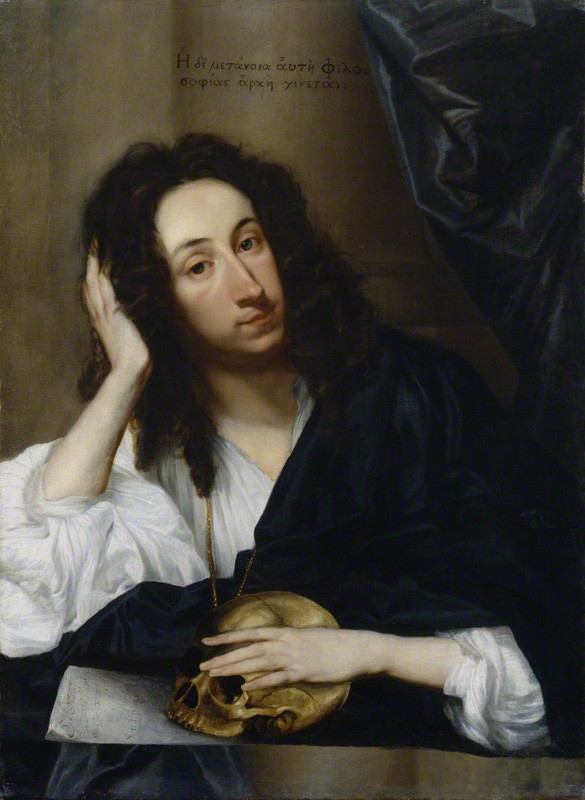
Reprints of primary sources
Bray, Willliam, ed. 1857. Diary and Correspondence of John Evelyn, Vol. 3. London: Henry Colburn. (See pg. 226)
Grant, Douglas, ed. 1956. The Phanseys of William Cavendish, Marquis of Newcastle, Addressed to Margaret Lucas. London: Nonsuch.
Secondary sources
Chambers, Douglas D.C. 2004-15. “Evelyn, John (1620–1706).” In Oxford Dictionary of National Biography (Online Edition, Jan 2008), edited by David Cannadine. Oxford: Oxford University Press. Link.
Hunter, Michael. 2004-15. “Founder members of the Royal Society (act. 1660–1663).” In Oxford Dictionary of National Biography (Online Edition), edited by David Cannadine. Oxford: Oxford University Press. Link.
Fitzmaurice, James. 2004. The Intellectual and Literary Courtship of Margaret Cavendish. Early Modern Literary Studies Special Issue 14. Link.
For image sources and permissions please see our image gallery.
5.1 The Philosophical Letters
The Philosophical Letters is a collection of letters written by Cavendish to a fictional interlocutor named ‘Madam.’ The work presents Cavendish’s natural philosophy and engages with the ideas of Hobbes, Descartes, Henry More, J.B. Van Helmont, and other seventeenth-century philosophers such as Robert Boyle and William Harvey. Among other topics, Cavendish discusses their mechanical explanations of perception, light and colours, the view that motion can be transferred, and their views on immaterial substances. She also discusses the limits of human knowledge, the implications of infinite matter, and causation.

Cavendish famously sent her own work to the doorsteps of potential interlocutors hoping for the same rigorous philosophical discussion her male counterparts enjoyed. Unsurprisingly, these attempts often went unanswered. For example, after receiving copies of her books on natural philosophy, Henry More wrote to Anne Conway that Cavendish “may be secure from anyone giving her the trouble of a reply.” (Conway Letters, 237). If Cavendish wanted to engage in philosophical debate, then, she had to rely on herself.
It is significant that Cavendish chose to make her fictional correspondent female. In doing so, she provides an example of what a robust philosophical debate may look like between two women. Although the Philosophical Letters consist only of Cavendish’s replies to Madam, Cavendish begins many letters by summarizing the concerns Madam has raised regarding previous arguments. “Madam” is intelligent, well-read, and very critical of Cavendish. This imagined criticism allows Cavendish to elaborate on, clarify, and defend the major claims she makes in her other philosophical texts. In the final section of the Philosophical Letters, Cavendish warns her female interlocuter that the public may not respond kindly to their shared interest in natural philosophy. Cavendish writes,
MADAM,
I Perceive, you take great delight in the study of Natural Philosophy, since you have not onely sent me some Authors to peruse, and give my judgment of their opinions, but are very studious your self in the reading of Philosophical Works: and truly, I think you cannot spend your time more honourably, profitably, and delightfully, then in the study of nature…I must beg leave to tell you, first, that some (though foolishly) believe, it is not fit for Women to argue upon so subtil a Mystery… (Cavendish 1664, 414-415)
Cavendish warns her female counterpart that she may face criticism for working in a field that is seen as unfit for women. Still, she encourages Madam to continue her studies in natural philosophy as nothing is more worthy of her time. Cavendish is intentional in her decision to showcase a debate between two women in the Philosophical Letters. Throughout the work, Cavendish demonstrates a careful study of central topics in 17th century natural philosophy.
5.2 Correspondence with Constantijn Huygens
Huygens, Constantijn (1596 – 1687) was Dutch diplomat, composer, poet, writer and scholar, and the father of the scientist and mathematician Christiaan Huygens. He was also the Secretary to two Princes of Orange, Frederick Henry and William II. Huygens grew up in the French-Dutch environment of the Netherlands, and was fluent in in Dutch, English, French, and Latin. As a result, he was extremely well connected in the political and scholarly circles on the European Continent and in England, with scholars estimating that he wrote and received more than 100,000 letters in his lifetime – 10,000 of which are still extant today. Among his correspondence are more than hundred-twenty letters with René Descartes, whom he assisted with the publication of his Discours de la Méthode (1637). He also maintained close relationships and numerous correspondence women. Among the aristocracy he kept in touch with Cavendish, Elizabeth Stuart Queen of Bohemia, and Queen Christina of Sweden, but he also kept in touch with female scholars such as Anna Maria Van Schurman, poets, ladies in waiting, and other female relations of his male contacts (Huysman and Leerintveld, 2014).
Content of correspondence
Huygens met Cavendish in person in Antwerp in 1657, when she and her husband were in political exile in Antwerp (1648-1660). They probably met once more in February 1658 (Akkerman & Corporaal, 2009.) They corresponded during her stay in the Netherlands and kept in touch even after Cavendish’s return back to England. Their extant correspondence dates from 1657-1671. The first four letters discuss the phenomenon of Rupert’s Drops, with both Cavendish and Huygens attempting to give an explanation. The drops were named after Prince Rupert of the Rhine who first brought the drops to England. The drops are produced by dripping molten glass into cold water, and the result is tadpole-shaped glass object which has very strange properties: the “head” is unbreakable and can withstand hammer blows, whereas the sligthest disturbance to the tail makes the entire object explode. The phenomenon was considered highly puzzling in the seventeenth century, with even the Sun King of France, Louis XIV, taking an interest. They were also debated by the Royal Society in London, and Robert Hooke discusses them in his work Micrographia (1665).
After her departure from Netherlands, Cavendish kept in touch with Huygens and regularly sent him new publications of her works. The next three letters concern Cavendish’s request to Huygens to present a gift volume of her works, including Poems and Fancies, Nature’s Pictures, The World’s Olio, and Philosophical and Physical Opinions, to the Rector of the University of Leiden. Huygens executed the request, and Rector presented in he works in a public meeting in front of the Academic Senate and sent Cavendish a grateful letter of acceptance. The volumes are still extant at the university library today (Akkerman & Corporaal 2009).
The final three letters of the correspondence are social and polite in nature.
Short and fun educational video on Rupert’s Drops from SmarterEveryDay.
Hooke’s description in Micrographia, courtesy of Hathi Trust (pp.33-44, also PDF below).
Extant correspondence
There are a total of eleven extant letters whose content scholars have access to. Eight of the letters that Huygens and Cavendish exchanged survive in manuscript: four by Huygens to Cavendish, and four by Cavendish to Huygens. There are three additional letters to supplement the correspondence: a letter from Huygens to Utricia Swann, which mentions Cavendish; a letter from Cavendish to Huygens which is in a private collection; and a letter from Huygens to Cavendish which is not extant, but which was reprinted by Sir William Cavendish after Cavendish’s death in A Collection of Letters and Poems Microform (1678). All of the letters are in English.
Until recently, the canonical edition of Huygens’s letters was by J.A. Worp, De Briefwisseling Van Constantijn Huygens (1916 & 1917). Worp’s edition was important for the preservation of Huygens’s correspondence, but it did not conform to current scholarly practices. For example, some of the letters are abridged or summarized, including two of the letters in the Cavendish-Huygens correspondence.
Akkerman & Corporaal research
Nadine Akkerman and Marguerite Corporaal’s recently brought attention to the Cavendish-Huygens correspondence, and identified two additional letters that are not in the Worp edition. One is in the Collection of Letters and one is in a private collection. They have also carefully transcribed the manuscripts, including Huygens’s corrections.
Their research and the transcript of the letters, including the two additional ones, is available online here.
Huygens Institute Digital Project
The Huygens Institute of Dutch History and National Library of the Netherlands provides a new digital edition of the complete Huygens correspondence, including that with Cavendish. The digital edition includes information on letter and manuscript location, manuscript images, links to relevant secondary literature, as well as PDF and OTC versions of the Worp edition. The digital edition also aims to aid scholars in letter analysis, including analysis of Huygens’s communication with women. Please note that the edition does not (as yet) include the two additional letters identified by Akkerman and Corporaal.
For more information on Huygens’s correspondence and the digital project see:
Huysman, I., and A. Leerintveld. 2014. “New Perspectives of the Digitized Correspondence of Constantijn Huygens (1596-1687).” Dutch Crossing Dutch Crossing 38 (3): 244-258.
The Cavendish letters can be found here.
Portal for all Huygens letters can be found here.
Downloads
Spreadsheet overview of correspondence: Excel file
Worp edition (includes 9 letters), courtesy of Huygens Institute digital project: PDF file
Robert Hooke’s discussion of Rupert’s Drops in Micrographia, courtesy of Hathi Trust: PDF file
Contents of letters
|
Date |
Author |
Content description |
|---|---|---|
| 5 / 15 September1653 | Huygens, Constantijn
(to Utricia Swann) |
Personal letter to Utricia, where he mentions Cavendish’s style of dress as the height of fashion, and her work Poems and Fancies. |
| 12 March 1657 | Huygens, Constantijn | Huygens asks Cavendish for her views on the phenomenon of Rupert’s Drops. |
| 20 March 1657 | Cavendish, Margaret | Cavendish thanks Huygens for some poetry and discusses the Rupert’s Drops. |
| 27 March 1657 | Huygens, Constantijn | Huygens discusses Rupert’s Drops. |
| 30 March 1657 | Cavendish, Margaret | Cavendish discuses Rupert’s Drops. |
| 27 October 1658 | Cavendish, Margaret | Cavendish asks Huygens to present her works to the University of Leiden. |
| 28 November 1658 | Huygens, Constantijn | In this letter, Huygens writes to Cavendish that he presented her works (gift volume including Poems and Fancies, Nature’s Pictures, The World’s Olio, and Philosophical and Physical Opinions) to the Rector of the University of Leiden. Enclosed he sends the thank you letter from the Rector. |
| 11 January 1659 | Cavendish, Margaret | Cavendish states that she was prevented from replying earlier because of a toothache. She thanks Huygens for his “great favor,” which scholars interpret as her thanking Huygens for presenting her works to the University of Leiden. |
| 15 July 1660 | Cavendish, Margaret | In the letter Cavendish asks Huygens for help with obtaining a pass so that her luggage could be transported back to England. |
| 2 / 12 August 1664 | Huygens, Constantijn | Huygens apologizes that although he is England he will not be able to see Cavendish because of his duties to the Court of France. He also thanks her for a gift of books that she has sent him in his absence at home. |
| 9 / 19 Sept. 1671 | Huygens, Constantijn | Huygens apologizes again that he has to leave England quickly wihout paying Cavendish his respects, and thanks her for all her previous favors to him. |
Reprints of letters
Akkerman, Nadine, and Marguérite Corporaal. 2004. “Mad Science Beyond Flattery: The Correspondence of Margaret Cavendish and Constantijn Huygens.” Early Modern Literary StudiesSpecial Issue 14 (2.1-21).
Note: Includes careful text transcripts of manuscripts, including Huygens’s corrections. Link.
Akkerman, Nadine, and Marguérite Corporaal. 2009. “Mad science beyond flattery: the correspondence of Margaret Cavendish and Constantijn Huygens.” In Margaret Cavendish, edited by Sara H. Mendelson, pp. 263-304. Farnham, England & Burlington, USA: Ashgate.
Note: Includes careful text transcripts of manuscripts, including Huygens’s corrections, as well as images of the manuscripts. See Appendix, pp. 272-302.
Worp, J. A., ed. 1916. De Briefwisseling van Constantijn Huygens, (1608-1687), Vols. V – 28. The Hague: Martinus Nijhoff Rijks Geschiedkundige Publicatiën.
______, ed. 1917. De Briefwisseling van Constantijn Huygens, (1608-1687), Vol VI – 32. The Hague: Martinus Nijhoff Rijks Geschiedkundige Publicatiën.
Vol. 5 / 28: pp. 186 -187, 285 -286, 287, 312, 313.
Vol. 6 / 32: pp. 88, 89, 293.
The Worp edition is available in two digital formats:
Hathi Trust: Vol. 5 only
Huygens Institute of Dutch History
Image of Constantijn Huygens forthcoming.
For image sources and permissions see our image gallery.
5.3 Correspondence with Joseph Glanvill
Joseph Glanvill (1636–1680) was a Church of England clergyman and philosopher, who some scholars interpret as influenced by the ideas of Henry More. In his work The Vanity of Dogmatizing(1661), he discusses topics such as Aristotelianism and Descartes, the possibility of certain knowledge, and causation. The work was controversial, and Glanvill responded to criticisms in his work Scepsis Scientific (1664). He dedicated the work to the Royal Society, which promptly elected him as a member. Glanvill spent the rest of his life defending the work of the Society and the new experimental methods of natural philosophy it embodied. Glanvill also became famous for his publications on witches. His posthumously published work on witches, Saducismus Triumphatus (1681), to which Henry More added some materials, became one of the best known works on the existence of witches, both in England and on the Continent. This may seem surprising for a member of the Royal Society, but at the time, the topic of witches was relevant to discussions of immaterial substances, materialism and atheism. He was not alone in his interest in the supernatural, and corresponded on the topic with philosophers such as Henry More and Robert Boyle.
Although Glanvill did not know Cavendish personally, he was one of the few scholars who engaged with her in philosophical debate. Some scholars suggest that this is because he was seeking Cavendish’s patronage. In either case, he sent Cavendish a copy of his first work on witchcraft, A Philosophical Endeavour Towards the Defense of the Being of Witches and Apparitions (1666), which led to correspondence between the two.
There are seven extant letters from John Glanvill to Cavendish which remain from this correspondence, all published in A Collection of Letters and Poems Microform (1678), which Cavendish’s husband Sir William published after her death. For philosophical analysis and historical context of the correspondence see Jacqueline Broad’s article “Margaret Cavendish and Joseph Glanvill: Science, Religion, and Witchcraft.” (2007)
Spreadsheet overview of correspondence: Excel file
Modern transcript of the letters: PDF file
Image of Glanvill’s work forthcoming.
Content overview
|
Letter |
Date |
Page |
Content |
|---|---|---|---|
| 1 | December, no year | 85 | Asks Cavendish to accept a copy of his book on witchcraft. |
| 2 | Undated | 98-100 | Thanks Cavendish for a present, distinguishes between two kinds of knowledge, and discusses the knowledge one can gain from experiments. |
| 3 | 13 October, no year | 102-103 | Discusses mechanism and vitalism, and asks Cavendish for a donation of books to the Bath library. |
| 4 | 25 August, no year | 104-105 | Thanks Cavendish for her present of a history book that she wrote (presumably the Life of William); mentions another of his works on witches and plastic faculties; and discusses disputes and his work on the subject; and mentions that he has not read a book on experimental philosophy that Cavendish wrote to him about. |
| 5 | 13 October 1667 | 123-127 | Discusses the nature of plastic faculties; Platonist views on souls and bodies; soul-body interaction; mentions Scepsis Scientifica; discusses the possibility of a theory of nature, and the state of natural philosophy and natural history; mentions the Royal Society.
He also discusses at length his views on the pre-existence of the souls and answers Cavendish’s questions and objections on the subject. Mentions Hobbes and materialism, and Henry Moore. |
| 6 | 22 April, no year | 135-136 | Pays Cavendish compliments and begs her to accept a gift of his work |
| 7 | 8 July, no year
|
137-142 | Responds to Cavendish’s arguments regarding witches; discusses the content regarding witches and sorcery in the Scripture and the Gospels.
Also discusses motion and mechanism; perfection of God; God’s relation to the created world; relationship between God and motion; mathematics and the works of nature. |
References
Burns, William E. 2004. “Glanvill , Joseph (1636–1680).” In Oxford Dictionary of National Biography (Online Edition). Oxford: Oxford University Press. Link.
Broad, Jacqueline. 2007. “Margaret Cavendish and Joseph Glanvill: Science, Religion, and Witchcraft.” Studies in History and Philosophy of Science 38 (3): 493-505.
Cavendish, William, Duke of Newcastle, ed. 1678. A Collection of Letters and Poems Microform / Written by Several Persons of Honour and Learning, upon Divers Important Subjects, to the late Duke and Dutchess of Newcastle. London: Printed by Langly Curtis in Goat Yard on Ludgate Hill.
For image sources and permissions see our image gallery.
5.4 Scholarly contacts
This section includes information about other scholars with whom Cavendish had contact, but where the correspondence is either limited, or non-extant.
In 1678, William Cavendish published A Collection of Letters and Poems Microform. The collection includes letters to Margaret Cavendish from Constantijn Huygens and Joseph Glanvill, but also six additional letters from other natural philosophers. The three letters from Walter Charleton mostly contain praise of Cavendish and her philosophy. The other three letters, one each from Kenelm Digby, Thomas Hobbes, and Henry More, are short notes expressing thanks for Cavendish’s presents of her works. For a brief overview of the letters see the table at the end of this section.
A modern transcript of the letters is available for download below. Please note that the original source comes from the Early English Books Online database. The letters were subsequently edited: the spelling and some of the grammar was modernized to make the text more accessible and a pleasure to read.
René Descartes
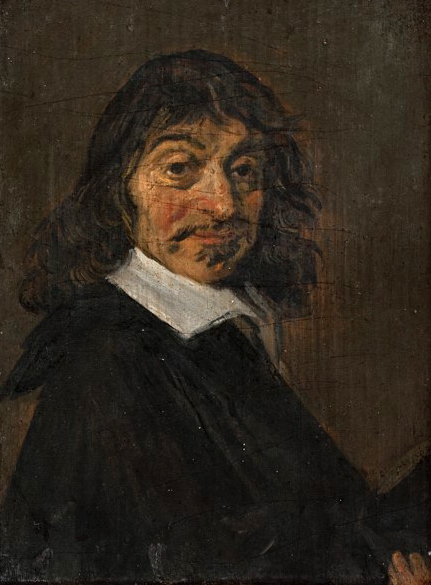
Cavendish also appears to have met Descartes (1596-1650), but there is scholarly debate on whether she ever even held a conversation with him, on the account of her not understanding French. In the front matter of her Philosophical and Physical Opinions (1655), Cavendish includes An Epiloge to My Philosophical Opinions, in which she discusses her contact with Descartes. Below is the relevant excerpt. For a complete transcript see Section 5.4.
“Some say that my book of philosophy, it seems as if I had conversed with Descartes or Master Hobbes, or both, or have frequented their studies, by reading their works, but I cannot say but I have seen them both, but upon my conscience I never spoke to Monsieur Descartes in my life, nor ever understood what he said, for he spoke no English, and I understand no other language, and those times I saw him, which was twice at dinner with my Lord at Paris, he did appear to me a man of the fewest words I ever heard.”
William and Charles Cavendish
Margaret Cavendish’s husband William Cavendish (1593-1676) was a writer, playwright, poet, Royalist army officer, and an enthusiastic patron of the new mechanical and experimental natural philosophy. He was the key patron of Thomas Hobbes. His brother Charles Cavendish (1595?–1654) was a mathematician and also a patron of natural philosophers and mathematicians. Through her marriage to William, Margaret also gained access to the brothers’ extensive network. There is, however, scholarly debate on how much personal intellectual contact she was actually able to have with the philosophers the Cavendishes cultivated.
Margaret dedicated many of her works to her husband. Notably, her first three works were dedicated to her friend and brother-in-law: Poems and Fancies (1653), Philosophical Fancies (1653), and The World’s Olio (1655) published shortly after his death. Charles passed away in 1654, but William continued to support Margaret’s writing until her death: with a few exceptions, almost all her works after 1655 include either a laudatory poem or a letter of support from William. There is also extant correspondence between Margaret and William from their courtship in 1645, see Section 5. (Research on other extant correspondence is forthcoming.)
By the 1630s, the brothers were known to be at the vanguard of natural philosophy, and promoted experiments in optics and mechanics, and new research in mathematics. They had a wide network of contacts, including their tutor and protégé Thomas Hobbes, the philosopher Francis Bacon, and the French philosopher Marin Mersenne. Charles also knew the English mathematician and fellow of Royal Society, John Pell, and the French mathematician Gilles de Roberval. The brothers were also in touch with the now less well-known French scholars François Derand and Claude Mydorge.
During their exile in in France the brothers became key patrons of the “Newcastle” or “Cavendish” philosophical circle, which brought together English and French philosophers, such as Walter Charleton, René Descartes, Kenelm Digby, Thomas Hobbes, Pierre Gassendi and Marin Mersenne. Through these, the circle had access to an even wider network of scholars. Charles was personally acquainted with Princess Elisabeth of Bohemia, who in turn corresponded with Descartes and commented on Digby’s views. Descartes would later tutor Queen Christina of Sweden. She and the Dutch scholar Anna Maria van Schurman were in turn in communication with Gassendi and Mersenne. The circle was thus indeed a circle.
Image of William Cavendish forthcoming.
Walter Charleton
Margaret Cavendish met Charleton through the Cavendish brothers, and the three extant letters indicate that they corresponded over an extended period of time (1654, 1663, 1667), both during Cavendish’s exile on the Continent and her later years in England. They also suggest that Charleton was an ardent admirer of her as a person, as well as of her works. The three letters are full of praise and indicate that he knew her works well. It is thanks to Charleton’s persistent lobbying that the Royal Society extended a formal invitation to Margaret to observe one of its sessions. (Mintz, 1952)
Walter Charleton (1620–1707) was a natural philosopher, physician, translator of J.B. Van Helmont, and key member of the “Cavendish” circle in Paris. Through his friendship with Kenelm Digby and acquaintance with Thomas Hobbes, he became a proponent of the new mechanical philosophy. He was instrumental in introducing Pierre Gassendi’s Epicurean natural philosophy to the English speaking audience, through his publication of the Physiologia Epicuro Gassendo Charltoniana(1654). He subsequently became known for a number of works on medical subjects such as human and animal anatomy, and the nature of the humans and animal soul. Some scholars suggest that he exerted important influence on later natural philosophers such as Robert Boyle and Isaac Newton.
Image of Walter Charleton forthcoming.
Kenelm Digby
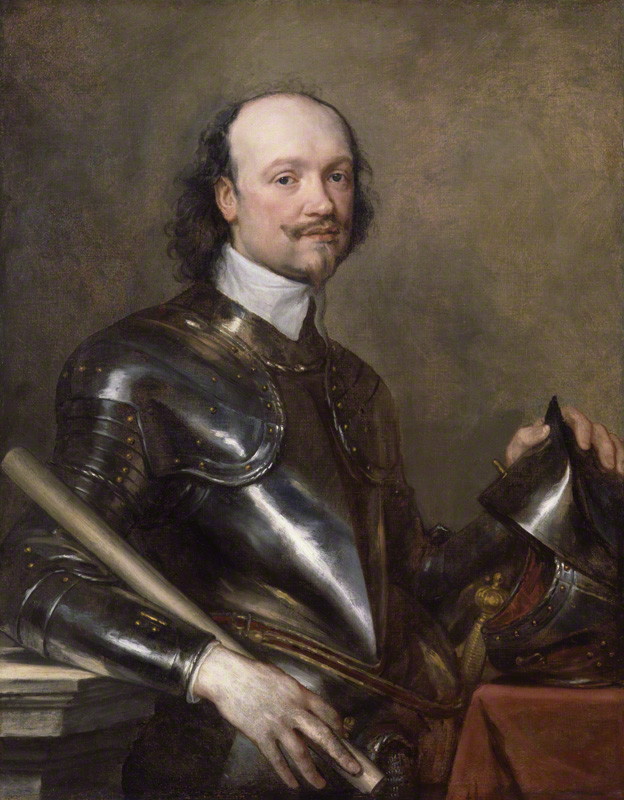
There is one extant thank you letter from Digby to Margaret from 1657. Kenelm Digby (1603-1665) was a natural philosopher and courtier, with a long standing interest in experimental chemistry and biology. His reconversion in 1634 to Roman Catholicism led him to travel in Europe, where he met Marin Mersenne and Thomas Hobbes in 1635-6, with whom he stayed in correspondence. Through Mersenne he was introduced to the works of Descartes, and engaged in a correspondence with him. Digby even traveled to meet Descartes in person in the Netherlands in 1640. In 1641, he finally fled to Paris into political exile, and became the Chancellor of Queen Henrietta Maria. At the time, Margaret Cavendish was her lady in waiting. During his exile in Paris, Digby was one of the key members of the Cavendish circle, and in 1644, he published two treatises on natural philosophy which made him one of the best known natural philosophers of the time: The Nature of Bodies and On the Immortality of Reasonable Souls, which discuss Aristotelianism, atomism and mechanical philosophy. In 1644 he also again met with Descartes. Digby returned to England in 1660, after the Restoration of the monarchy, became one of the founding members of the Royal Society. He continued to pursue his interests in chemistry and biology, corresponded with the great French mathematician Pierre de Fermat, and invented the modern wine bottle.
Thomas Hobbes
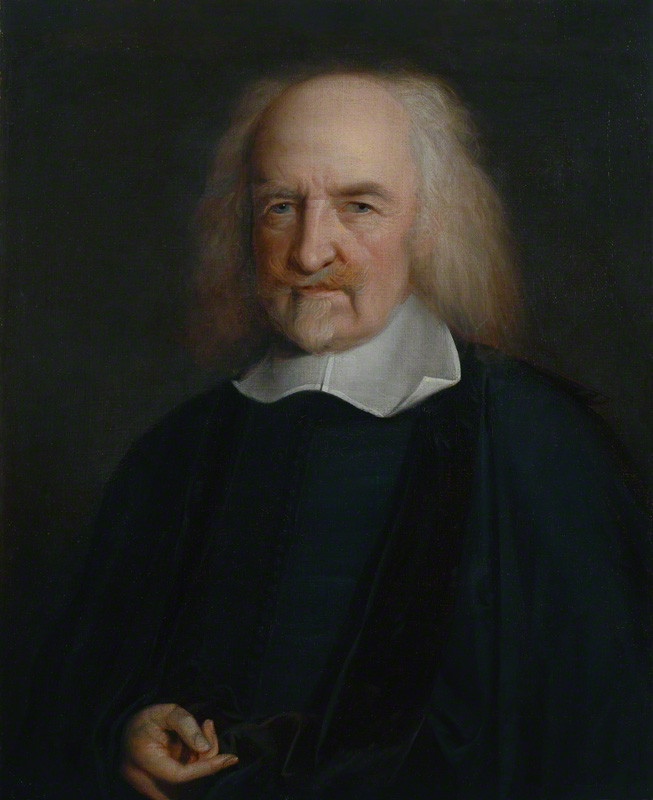
There is one extant thank you letter from Hobbes to Margaret from 1661. In the front matter of her Philosophical and Physical Opinions (1655), Cavendish includes ‘An Epiloge to My Philosophical Opinions’, in which she discusses her contact with Hobbes. For a complete transcript see Section 5.4.
“And for Master Hobbes, it is true I have had the like good fortune to see him, and that very often with my Lord at dinner, for I conversing seldom with any strangers, had no other time to see those two famous philosophers; yet I never heard master Hobbes to my best remembrance treat, or discourse of philosophy, nor I never spoke to Master Hobbes twenty words in my life, I cannot say I did not ask him a question, for when I was in London I met him, and told him as truly I was very glad to see him, and asked him if he would please to do me that honour to stay at dinner, but he with great civility refused me, as having some business, which I suppose required his absence.”
Thomas Hobbes (1588–1679) was a natural philosopher, mathematician, and is today best known for his materialist philosophical views and authorship of the political treatise The Leviathan (1651). He was a close companion of the Cavendish brothers. In 1608, he became William Cavendish’s tutor and took William on a tour of the Continent where they engaged with many scholars. Through Cavendish, Hobbes also became acquainted with the natural philosopher Francis Bacon and engaged in secretarial work for him. Later, he became William’s assistant and William his patron, and together they pursued interests in optics and mechanics, including an interest in microscopes and telescopes. Hobbes fled to Paris in 1641 for political reasons, and reconnected with the Cavendish brothers in 1645, when they also fled into political exile. It is as part of the Cavendish circle that Margaret had the opportunity to meet Hobbes and learn about his materialist ideas, though there is scholarly debate as to what extent she had any personal contact with him. Hobbes also became a mathematics tutor to the future Charles II from 1647-1648.
After the publication of the Leviathan in 1651 Hobbes fell out of favor with the French court in Paris and returned to England. While in England, he published De Corpore (1655) a work which spelled out his natural philosophy and contained a mathematical proof (unsuccessful as it turns out) of squaring the circle. The work provoked a bitter debate with the mathematician John Wallis. Hobbes also engaged in a famous debate with Robert Boyle on the validity of the experimental approach to natural philosophy and the existence of vacuum. He managed to estrange most of the leading natural philosophers of the day and was never, to his dismay, invited to join the Royal Society.
Henry More
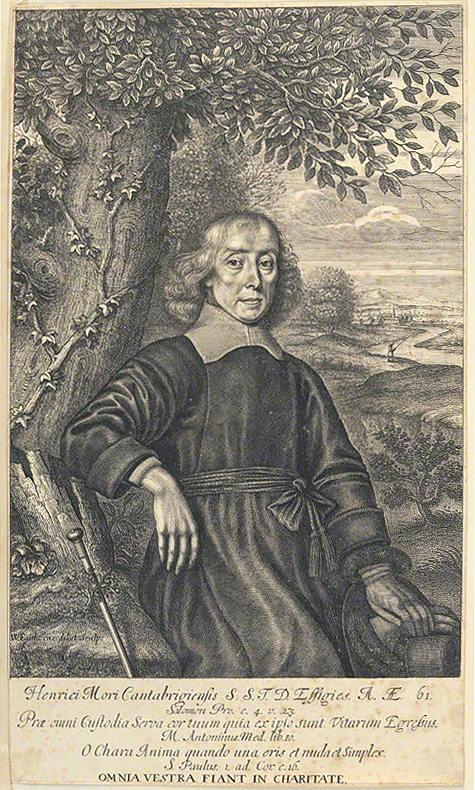
There is one extant thank you letter from More to Margaret from 1663. (For an overview of Henry More, see Section 5.2 of Conway.) In 1665, Margaret sent More a present of her works including Poems and Fancies (1653) and Philosophical Letters (1664), which prompted the extant thank you letter. Scholars often interpret the Philosophical Letters as a pointed attack on the philosophy of Descartes, Hobbes, More and J.B. Van Helmont. More wrote regarding the present to Conway, in his letter from 15 May 1665 (Letter 156 in the Conway Letters, 1992, pg. 237). Some scholars also read the letter as More suggesting – perhaps in jest – that Conway reply to Cavendish and that he did not take Cavendish’s work seriously (Hutton, 2004). Either way, Conway, as far as we know, did not reply to the letter and the two women philosophers did not come into contact. See Section 6.3 for the relevant quote from the letter.
Overview of letter contents
|
Item |
Author |
Date |
Page |
Content |
|---|---|---|---|---|
| 29 | Digby | 9 June 1657 | 65 | Short thank you letter for a present of her works. |
| 32 | Hobbes | 9 February 1661 | 67-68 | Short thank you letter for a present of her works. |
| 47 | More | 3rd May 1663 | 91-93 | Short thank you letter for a present of her works. |
| 48 | Charleton | 3 May 1663 | 91-93 | Thanks Cavendish for present of her works. Panegyric on Cavendish’s talents. |
| 59 | Charleton | 7th May 1667 | 108-119 | Thanks Cavendish for present of her works. Panegyric on Cavendish’s talents. Mentions Galileo; Stoics – Zeno, Cleanthes, Chrysippus; commentary on her natural philosophy, morals and poetry.
Natural philosophy section: mentions skepticism regarding knowledge; Royal Society and its examinations of theories of nature; mentions Aristotle, Democritus, Epicurus, Descartes, Hobbes – calls their views “plausible conjectures at best”; Aristotle on the humane soul. Does not wish to adjudicate between these and Cavendish’s philosophy. Consoles Cavendish for the lack of reception of her philosophy at universities; comments on the entrenchment of Aristotelianism. Morals section: comments on her different uses of genre to communicate her moral views. Poetry section: comments positively on her poetry and her originality; compliments her on exceeding all women past and present, using examples from Roman times. |
| 73 | Charleton | 1 January 1654
|
142-149 | Thanks Cavendish for her present of The World’s Olio. Complimentary commentary on the work. Writs that Cavendish has benefited his reputation and his philosophical thought.
Also discusses her professed non-contact with scholars; comments on the view of others that she did have such contact; comments on her use of technical terms from the fields of theology, philosophy, medicine, mathematics, and astronomy. Comments on the positive moral effects of her written works. |
References
Carlyle, E.I. 2004-15. “Cavendish, Sir Charles (1595?–1654).” In Oxford Dictionary of National Biography (Online Edition), edited by David Cannadine. Oxford: Oxford University Press. Link.
Foster, Michael. 2009. “Digby, Sir Kenelm (1603–1665).” In Oxford Dictionary of National Biography (Online Edition Jan 2009), edited by David Cannadine. Oxford: Oxford University Press. Link.
Henry, John. 2010. “Charleton, Walter (1620–1707).” In Oxford Dictionary of National Biography (Online Edition Sept. 2010), edited by David Cannadine. Oxford: Oxford University Press. Link.
Hulse, Lynn. 2004-15. “Cavendish, William, First Duke of Newcastle upon Tyne (bap. 1593, d. 1676).” In Oxford Dictionary of National Biography (Online Edition Jan. 2011), edited by David Cannadine. Oxford: Oxford University Press. Link.
Hutton, Sarah, and Marjorie Hope Nicolson, eds. 1992. The Conway Letters: the Correspondence of Anne, Viscountess Conway, Henry More, and Their Friends, 1642-1684. Oxford: Clarendon.
______. 2004. Anne Conway: a Woman Philosopher. Cambridge: Cambridge University Press.
______. 2008. “More, Henry (1614–1687).” In Oxford Dictionary of National Biography (Online Edition Jan. 2008), edited by David Cannadine. Oxford: Oxford University Press. Link.
Malcolm, Noel. 2010. “Hobbes, Thomas (1588–1679).” In Oxford Dictionary of National Biography (Online Edition Sept. 2010), edited by David Cannadine. Oxford: Oxford University Press. Link.
Mintz, Samuel. 1952. “The Duchess of Newcastle’s Visit to the Royal Society.” The Journal of English and German Philology 51: 168-76.
For image sources and permissions see our image gallery.
5.5 Front matter in Cavendish’s works
Much as today’s academic works contain forewords and acknowledgments, prefaces, introductions, and other kinds of front matter before the actual text, so did many scholarly works in the early modern era. Cavendish’s works were no exception and she made frequent use of various kinds of front matter pieces to communicate with her audience.
The front matter in her works includes numerous items such as dedicatory letters, laudatory poems by her husband, prefaces, letters to readers and friends, and most daringly, addresses to natural philosophers and universities. Cavendish did not have many scholarly interlocutors who were willing to engage with her in a public philosophical debate. Therefore one way to interpret the front matter of her works is as her way of corresponding with eminent scholars and philosophers. The recipients could not refuse Cavendish’s presents of her own works due to her high social rank, and were obliged to acknowledge receipt by means of appropriately polite thank you letters. Some of these can be found in William Cavendish’s A Collection of Letters and Poems Microform (1678).
Cavendish wrote a letter to ‘Naturall Philosophers’ in her Poems and Fancies (1653, 1664, 1668); a letter to ‘All Professors of Learning and Art’ in her Sociable Letters (1664); and a letter to ‘The Most Famous University of Cambridge’ in her Philosophical Letters (1664) and in her Observations Upon Experimental Philosophy & The Blazing World (1666, 1668).
Front matter to Philosophical and Physical Opinions
The front matter of the three printings of her Philosophical and Physical Opinions (PPO) went through revisions. The first publication in 1655 includes a letter to the ‘Two Universities’ of Oxford and Cambridge and a ‘Condemning Treatise of Atomes.’ It also contains a letter from William Cavendish, Duke of Newcastle, defending the originality of Cavendish’s thought: ‘An Epistle to Justify the Lady Newcastle…’ The second publication in 1663 does not include these pieces, but instead includes ‘A Preface Concerning the Rules of Art, and Explaining the Nature of the Infinite, Together with Some Other Terms, for the Better Understanding of this Philosophical Work.’ The third publication, and second edition of PPO in 1668, renamed Grounds of Natural Philosophy, only contains the boldly titled letter ‘To All the Universities of Europe.’
Dedication to the Grounds of Natural Philosophy
A table overview of the front matter in each of Cavendish’s works and their editions is available below. Our team is currently working on a modern transcription of the front matter and research on its interpretation is forthcoming. As a taster, we include here the dedication from the Grounds of Natural Philosophy (1668). Please note that the original source comes from the Early English Books Online database. The dedication was subsequently edited: the spelling and some of the grammar was modernized to make the text more accessible and a pleasure to read.
TO ALL THE UNIVERSITIES IN EUROPE.
Your most humble servant, and admirer, Margaret Newcastle.
Editions and their front matter
|
Source |
Year |
Brief description of front matter |
|---|---|---|
| Poems and Fancies | 1653
|
The Epistle Dedicatory: to Sir Charles Cavendish, my Noble Brother-in-Law. Letter. Signed M.N.
To all Noble, and Worthy Ladies. Letter. Signed M.N. An Epistle to Mistris Toppe. Letter. Signed M.N. Letter signed E. Toppe. To Naturall Philosophers. Letter. To the Reader. Letter. The Poetresses Hasty Resolution. In verse. The Poetresses Petition. In verse. An Excuse for so much Writ upon my Verses. In verse. |
| Philosophical Fancies | 1653
|
A Dedication to Fame. In verse.
An Epistle to Time. In verse. A Request to Time. In verse. An Epistle to my Braine. In verse. An Epistle to a Troubled Fancy. In verse. An Epistle to Contemplation. In verse. An Epistle to Musefull Thoughts. In verse. Answer to the Thoughts. Reason, and the Thoughts. To Sir Charles Cavendish, my Noble Brother-in-Law. Letter. Signed M.N. To the Reader. And a Table of contents. |
| The World’s Olio
|
1655 | A Dedication to Fortune. Letter. Signed Margaret Newcastle.
An Epistle that was Writ before the Death of the Noble Sir Charls Cavendish, my Most noble Brother-in-Law.Letter. Margaret Newcastle. An Epistle to the Reader. Letter. The Preface to the Reader. Letter. To the Reader. Letter. Signed M.N. To the Lady of Newcastle, upon her Book Intituled, the World’s Olio. |
| Philosophical and Physical Opinions
|
1655 | To the Lady Marqvesse of Newcastle, on her Book Intitled her Philosophicall, and Physicall Opinions. In verse. Signed W. Newcastle.
An Epistle to Justifie the Lady Newcastle, and Truth Against Falshood, Laying those False, and Malicious Aspersions of her, that she was not Authour of her Books. Letter. Signed W. Newcastle. To the Reader. Letter. To the Two Universities. Letter. An Epiloge to my Philosophical Opinions. Letter. An Epistle to my Honourable Readers. Letter. An Epistle to the Reader, for my Book of Philosophy.Letter. An Epistle to my Readers. Letter. An Epistle to my Readers. Letter. A Condemning Treatise of Atomes. Letter. The Opinion, or Religion of the Old Philosophers. Letter. The Text to my Natural Sermon. Letter. |
| Nature’s Pictures | 1656
|
The Dedication. In verse.
To the Lady Marchioness on her Book of Tales. In verse. Signed W. Newcastle. A Copy of Verses to the Lady Marchioness of Newcastle. In verse. Signed W. Newcastle. To the Reader. Letter. An Epistle to my Readers. Letter. Signed M. Newcastle. To the Reader. Letter. Signed M. Newcastle. To the Reader. Letter. Signed M. Newcastle. To the Reader. Letter. Signed M. Newcastle. To My Readers. Letter. To My Readers. Letter. Signed M. Newcastle. |
| Plays | 1662
|
The Dedication.
The Epistle Dedicatory. Letter. Signed M.N. To the Readers. Letter. Signed M.N. To the Readers. Letter. Signed M.N. To the Readers. Letter. Signed M.N. To the Readers. Letter. Signed M.N. To the Readers. Letter. Signed M.N. To the Readers. Letter. Signed M.N. To the Readers. Letter. Signed M.N. To the Readers. Letter. Signed M.N. To the Readers. Letter. Signed M.N. Untitled postscript. Letter. Signed M.N. To the Lady Marchioness of Newcastle upon her Playes.Verse. Signed W. Newcastle. A General Prologue to all my Playes. Back matter: To the Readers. A letter. |
| Orations of Divers Sorts
|
1662 | To the Lady Marchioness of Newcastle on her Book of Orations. In verse. Signed W. Newcastle.
To His Excellencie the Lord Marquis of Newcastle. Letter. Signed M. Newcastle. To the Readers of my Works. Letter. Signed M. Newcastle. |
| Orations of Divers Sorts, 2nd printing | 1663 | To the Lady Marchioness of Newcastle on her Book of Orations. In verse. Signed W. Newcastle.
To His Excellencie the Lord Marquis of Newcastle. Letter. Signed M. Newcastle. To the Readers of my Works. Letters. Signed M. Newcastle. |
| Philosophical and Physical Opinions
2nd printing
|
1663 | To the Lady Marchioness of Newcastle on her Book of Philosophy. In verse. Signed William Newcastle.
To His Excellence the Lord Marquis of Newcastle. Letter. Signed Margareta Newcastle. Noble Readers. Letter. To the Reader. An Epistle to the Reader. Another Epistle to the Reader. A Preface Concerning the Rules of Art, and Explaining the Nature of Infinite, Together with Some Other Terms, for the Better Understanding of this Philosophical Work. |
| Sociable Letters | 1664
|
To The Lady Marchioness Of Newcastle, On Her Book Of Epistles. In verse. Signed W. Newcastle.
To His Excellency the Lord Marquess of Newcastle. Letter. Signed M. Newcastle. To All Professors of Learning and Art. Letter. Signed M.N. The Preface. Letter. Upon her Excellency the Authoress. Verse. To the Censorious Reader. Verse. |
| Philosophical Letters | 1664
|
To Her Excellency the Lady Marchioness of Newcastle, on her Book of Philosophical Letters. In verses. Signed W. Newcastle.
To His Excellency the Lord Marquis of Newcastle. Letter. Signed M.N. To the Most Famous University of Cambridge. Letter. Signed M. Newcastle. A preface to the reader. Signed M.N. |
| Poems and Fancies, 2nd ed. | 1664 | To the Lady Marchioness of Newcastle on her Book of Poems. In verse. Signed W. Newcastle.
The Epistle Dedicatory: to Sir Charles Cavendish, my Noble Brother-in-Law. Letter. Signed M.N. To all Noble, and Worthy Ladies. Letter. Signed M.N. An Epistle to Mistris Top. Letter. Signed M.N. To her Excellence the Lady Marchioness of Newcastle.Letter. Signed E. Top. To Natural Philosophers. Letter. To the Reader. Letter. The Poetresses Hasty Resolution. In verse. The Poetresses Petition. In verse. An Apology for Writing so Much on This Book. In verse. |
| The Blazing World | 1666
|
To the Duchesse of Newcastle, on her New Blazing-World. In verse. Signed William Newcastle.
To the Reader. |
| Observations upon Experimental Philosophy & The Blazing World
|
1666 | To Her Grace the Duchess of Newcastle on her Observations Upon Experimental Philosophy. In verse. Signed William Newcastle.
To His Grace the Duke of Newcastle. Letter. Signed M.N. To the Most Famous University of Cambridg. Letter. Signed Devoted Servant. The Preface to the Ensuing Treatise. To the Reader. An Argumental Discourse. Also The Table of all the Principal Subjects Contained and Discourse of in this Book. |
| The Life of William
|
1667 | To His Most Sacred Majesty Charles the Second. Letter. Signed Margaret Newcastle.
To His Grace the Duke of Newcastle. Letter. Signed M. Newcastle. The Preface. An Epistle to her Grace the Duchess of Newcastle. Letter. Signed John Rolleston (?). |
| The Blazing World, 2nd ed | 1668
|
To the Duchesse of Newcastle, on her new Blazing-World. In verse. Signed William Newcastle.
To All Noble and Worthy Ladies. Letter. Signed M. Newcastle. |
| Grounds of Natural Philosophy
(3rd printing and 2nd edition of Philosophical and Physical Opinions) |
1668 | To All the Universities of Europe. Letter. Signed Margaret Newcastle.
Also a Table of Contents (13 parts) and an Appendix (5 parts). |
| Observations Upon Experimental Philosophy & the Blazing World, 2nd ed.
|
1668 | To her Grace the Duchess of Newcastle on her Observations Upon Experimental Philosophy. In verse. Signed William Newcastle.
To his Grace the Duke of Newcastle. Letter. Signed M.N. To the Most Famous University of Cambridg. Letter. Signed M.N. The Preface to the Ensuing Treatise. To the Reader. An Argumental Discourse. Also The Table of all the Principal Subjects Contained and Discourse of in this Book. |
| Orations of Divers Sorts, 2nd ed.
|
1668 | To the Lady Marchioness of Newcastle on her Book of Orations. In verse. Signed W. Newcastle.
To His Excellencie the Lord Marquis of Newcastle. Letter. Signed M. Newcastle. To the Readers of my Works. Letters. Signed M. Newcastle. |
| The Life of William, Latin edition by Walter Charleton
|
1668 | Epigramma.
Aliud. Augustissimo Regi, Carolo II. Britanniarum Monarchae Inclyto, Margareta Novi-castelli Ducissa, Felicitatem, Victorias, Triumphos. Letter. D. Guilielmo Duci Novo-Castrensi. Letter. Signed Margareta N.C. Prefato. Letter. |
| Plays, Never Before Printed | 1668 | To the Readers. Letter. |
| Poems and Fancies, 3rd ed. | 1668 | To her Grace the Duchess of Newcastle on her Book of Poems. In verse. Signed W. Newcastle.
The Epistle Dedicatory to Sir Charles Cavendish, my Noble Brother-in-Law. Letter. Signed M.N. To all Noble, and Worthy Ladies. Letter. Signed M.N. An Epistle to the Lady Toppe. Letter. Signed M.N. To her Grace the Duchess of Newcastle. Letter. Signed E. Toppe. To Natural Philosophers. Letter. To the Reader. Letter. The Poetresses Hasty Resolution. In verse. The Poetresses Petition. In verse. An Apology for Writing so Much on This Book. In verse. |
| Nature’s Pictures, 2nd ed. | 1671 | The Duke of Newcastle upon All the Works of his Duchess.In verse.
Preface. Letter and poem. Signed Margaret Newcastle. |
| The World’s Olio, 2nd ed. | 1671 | A Dedication to Fortune. Letter.
To his Grace the Duke of Newcastle. Letter. Signed Margaret Newcastle. An Epistle that was Writ before the Death of the Noble Sir Charls Cavendish, my Most noble Brother-in-Law.Letter. Margaret Newcastle. Advertisement to the Reader. Letter. The Preface. Letter. The Duke of Newcastle upon his Duchess’s World’s Olio. |
| The Life of William (posthumous edition) | 1675 | To his Most Sacred Majesty Charles the II. Letter. Signed Margaret Newcastle.
To his Grace the Duke of Newcastle. Letter. Signed M. Newcastle. The Preface. An Epistle to her Grace the Duchess of Newcastle. Letter. Signed John Rolleston (?). |
For image sources and permissions see our image gallery.
6. Connections
Thanks to her marriage to the influential William Cavendish, Duke of Newcastle, and his brother Charles Cavendish, Margaret Cavendish had access to a wide network of scholars and natural philosophers in England, as well as on the Continent. The table below provides a brief description of her connections with these. Where possible, we have also tried to indicate how her connections were related to those of the other women philosophers.
The following sections also present quotes by well known male philosophers, which express their views of Cavendish.
Additional resources include:
The Digital Cavendish Project
The Project presents original research on Cavendish’s personal connections and works, including:
Network analysis by Shawn W. Moore, PhD candidate at Texas A&M University who is a curator of The Digital Cavendish Project.
Neatline Classroom map of Cavendish’s travels.
Network “map” of her relationships – below is a sample, but the Digital Cavendish Project allows for a dynamic and detailed exploration of the network nodes.
The Creative Commons license for the image below can be found here.

Six Degrees of Francis Bacon Project
The Project aims to map out early modern social networks. The network map provides a unified and systematized visual representation of the way people in early modern England were connected.

Connections overview
|
Scholar |
Connection
|
|---|---|
| Boyle, Robert
(1627-1691) |
Natural philosopher and proponent of experimental and mechanical philosophy. Key founding member of the Royal Society. Cavendish watched him perform various experiments at the Royal Society on May 30th, 1667. |
| Cavendish, Charles
(1595?–1654) |
Mathematician and patron of mathematicians, who had an extensive scholarly network in England and on the Continent. Cavendish’s friend and brother-in-law. Personal acquaintance of Princess Elisabeth of Bohemia, who in turn corresponded with Descartes and commented on Digby’s views. |
| Cavendish, William
(1593 – 1676) |
Cavendish’s husband, writer, poet, playwright, Royalist army officer, equestrian, and virtuoso. Student and long-term patron of Thomas Hobbes. Key leader of the Cavendish circle in Paris. Supported Margaret Cavendish in her publications throughout her lifetime. |
| Charleton, Walter
(1620–1707) |
Physician, natural philosopher, translator of J.B. Van Helmont, and fellow of the Royal Society. Close friend of Kenelm Digby and acquaintance of Thomas Hobbes. He knew the Cavendish brothers well and had regular correspondence with Margaret Cavendish. Instrumental in obtaining an invitation for her to visit the Royal Society in 1667. |
| Descartes, René
(1596-1650) |
Philosopher known for his dualist views and critique of Aristotelianism. Cavendish met him in Paris through her husband’s circle. Descartes corresponded with Princess Elisabeth of Bohemia, who knew Charles Cavendish. Descartes would later tutor Queen Christina of Sweden. |
| Digby, Kenelm
(1603 – 1665) |
Natural philosopher, courtier, and one of the founding members of the Royal Society. He is known for his interest in experimental chymistry and biology. Cavendish knew him through her husband’s circle and corresponded with him. |
| Evelyn, John
(1620-1706) |
Writer, diarist, botanist, and one of the founding members of the Royal Society. Cavendish corresponded with him. |
| Gassendi, Pierre
(1592-1655) |
Natural philosopher, mathematician, astronomer and clergyman. He was part of the Cavendish circle in Paris. There is no evidence that Cavendish had any contact with him, but she is likely to have been exposed to his philosophy through others in the Circle. He was also in contact with Dutch scholar Anna Maria van Schurman and Queen Christina of Sweden. |
| Glanvill, Joseph
(1636–1680) |
Church of England clergyman, philosopher and fellow of the Royal Society. He corresponded with Cavendish on philosophical topics such as the pre-existence of the souls and witches. |
| Hobbes, Thomas
(1588–1679) |
Natural philosopher and mathematician, known for his materialist philosophical views and his attempt to ‘square the circle.’ Never a member of the Royal Society. Long-term close friend and tutor of the Cavendish brothers. Margaret Cavendish met him in Paris and corresponded with him. |
| Hooke, Robert
(1635–1703) |
Natural philosopher, architect, curator of experiments for the Royal Society, pioneer of microscopy, and Robert Boyle’s assistant. There is no evidence that Cavendish was in contact with him, but she may have met him during her visit to the Royal Society in 1667. Her work Observations is often interpreted as a direct attack on his Micrographia. |
| Huygens, Constantijn
(1596 – 1687) |
Dutch court diplomat, composer, writer, polyglot, and father of the scientist and mathematician Christiaan Huygens. He corresponded with Cavendish on the subject of Rupert’s Drops and assisted her in presenting her works to the University of Leiden. |
| Mersenne, Marin
(1588–1648) |
Theologian, natural philosopher, mathematician and priest. He hosted regular meetings with philosophers in Paris and was influential in spreading Descartes’s works, including to the Cavendish circle. He was also in contact with Dutch scholar Anna Maria van Schurman and Queen Christina of Sweden. There is no evidence that Cavendish had any contact with him, but she is likely to have been exposed to his ideas through the Circle. |
| More, Henry
(1614–1687) |
Philosopher, poet, theologian and a long-term close friend and mentor of Conway. He corresponded with Cavendish, but scholars interpret him as not taking her philosophical work seriously. |
6.1 Quotes from Constantijn Huygens
The following quotes are from Huygens’s letters to Cavendish. The quotes are taken from the Worp edition, which modernizes the text transcript, making the English more accessible.
For a more accurate text transcript of the manuscripts, including Huygens’s corrections, see the Akkerman article. The Akkerman transcriptions are also available online here.
For images of the manuscripts themselves, digital copies of the Worp edition letters, and links to relevant secondary sources, see the Huygens Institute digital correspondence project.
5/15 September 1653, Huygens to Utricia Swann-Ogle, regarding Cavendish
“I am falled upon this lady by the late lecture of her wonderfull booke, whose extravagant atomes kept me from sleeping a great part of last night in this my little solitude…”
– Worp, Letter 5311, pg. 187; Akkerman, Letter 1, pg. 272.
12 March 1657, Huygens to Cavendish
“I had the honour to heare so good solutions given by your Excellencie upon divers questions mooved in a whole afternoone, she was pleased to bestowe upon my unworthie conversation, that I am turning to schoole with all speed, humbly beseeching your Excellency may bee so bountifull towards my ignorance, as to instruct me about the natural reason of these wonderfull glasses…”
“But, as I was bold to tell your Excellency, I should bee loth to believe, any female feare should reigne amongst so much over-masculine wisdom as the world doth admire in her. I pray God to blesse your Excellency with a dayly increase of it, and your worthie selfe to grannt that amongst those admirers I may strive to deserve by way of my humble service the honour to be accounted…”
– Worp, Letter 5334, pg. 284; Akkerman, Letter 2, pg. 276.
27 March 1657, Huygens to Cavendish
“I am the bolder in importunating her with these trifles, for as much I remember, your Excellency would declare unto me, that beeing to day of an opinion in matter of philosophie, she would not so be bound to it that tomorrow she might not make choice of a better. I leave all to her most ingenious perspicacitie…”
– Worp, Letter 5337, pg. 287; Akkerman, Letter 4, pg. 286.
9/19 September 1671, Huygens to Cavendish
“I could not forbeare to shew your Grace by these lines how verily mindfull I am of the many favours she hath been pleased to bestow upon me beyond sea in former times, even especially of those favours Madam which I remember did cost your Grace many a white petticoat a week. I make no question Madam, but the same noble veine is producing still some new rarities, and pray God it may continue to doe so many happy years to the glory of your name and satisfaction of the world …”
– Worp, Letter 6807, pg. 293; Akkerman, Letter 11, pg. 302.
Sources
Akkerman, Nadine, and Marguérite Corporaal. 2009. “Mad science beyond flattery: the correspondence of Margaret Cavendish and Constantijn Huygens.” In Margaret Cavendish, edited by Sara H. Mendelson, pp. 263-304. Farnham, England & Burlington, USA: Ashgate.
Worp, J. A., ed. 1916. De briefwisseling van Constantijn Huygens, (1608-1687), Vols. V – 28. The Hague: Martinus Nijhoff Rijks Geschiedkundige Publicatiën.
______, ed. 1917. De briefwisseling van Constantijn Huygens, (1608-1687), Vol VI – 32. The Hague: Martinus Nijhoff Rijks Geschiedkundige Publicatiën.
Image of Huygens forthcoming.
For image sources and permissions see our image gallery.
6.2 Quotes from Joseph Glanvill
The following quotes are from Glanvill’s letters to Cavendish.
22 April 1667, pg. 98-99
“And though I must crave your pardon for dissenting from your Grace’s opinion in some things, I admire the quickness, and vigor of your conceptions, in all: in which your Grace hath this peculiar among authors that they are, in the strictest sense, your own, your Grace being indebted to nothing for them, but your own happy wit, and genius; a thing so uncommon even among the most celebrated writers of our Sex, that it ought to be acknowledged with wonder in yours. And really, Madam, your Grace hath set us a patern, that we ought to admire, but cannot imitate. “
22 April, no year, pg. 135-136
“Ever since I had the happiness to see any of your Grace’s most ingenious writings, I have felt a mighty desire to speak my particular gratitude for those singular composures to all which the world is obliged … I am, Madam, an admirer of rarities, and your Grace is really so great an one, that I cannot but endeavour some testimony of a proportion’d respect and wonder…”
“For your Grace hath convinced the world, by a great instance, that women may be philosophers, and, to a degree fit for the ambitious emulation of the most improved masculine spirits.”
Source
Cavendish, William, Duke of Newcastle, ed. 1678. A Collection of Letters and Poems Microform / Written by Several Persons of Honour and Learning, upon Divers Important Subjects, to the late Duke and Dutchess of Newcastle. London: Printed by Langly Curtis in Goat Yard on Ludgate Hill.
For image sources and permissions see our image gallery.
6.3 Quotes from Henry More
The following quotes are from letters written by Henry More to Conway. In the first quote, he refers to Cavendish’s Philosophicall Letters: or Modest Reflections upon some Opinions in Natural Philosophy, Maintained by Several Famous and Learned Authours of this Age. … By the Thrice Noble, Illustrious, and Excellent Princess, the Lady Marchioness of Newcastle (1664). In the second quote, More refers to two folios, which Hutton (2004, pg. 114) identifies as Poems and Fancies(1653) and Philosophical Letters (1664). The letters are reprinted in Marjorie Nicolson’s edition of Conway’s letters (1930), and the revised edition of the same by Sarah Hutton (1992).
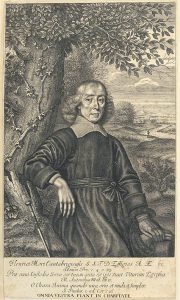
Early March, 1664–65
“But I am not fallen upon by one hand alone, I am spar’d by neither sexe. For I am also inform’d that the Marchionesse of Newcastle has in a large book confuted Mr Hobbs, Des Cartes, and myself, and (which will make your Ladiship at least smile at the conceit of it) Van Helmont also to boot.”
Letter 156, from Henry More to Lady Anne Conway, pg. 237
15 May 1665
“My Lady of Newcastle has sent two more Folios of hers to furnish my study, the one of poems, the other which is far the bigger, of letters wherein I am concern’d, above 30 of those letters being intended for a confutation of sundry passages in my writings. She is by farr a more civill Antagonist then Dr Beaumont, I wish your Ladiship were rid of your headache and paines, though it were no exchange for those of answering this great Philosopher. She is affrayd some man should quitt his breeches and putt on a petticoat to answer her in that disguize, which your Ladiship need not. She expresses this jealousie in her book, but I beleave she may be secure from any one giving her the trouble of a reply.”
Sources
Cavendish, Margaret. 1664. Philosophical Letters. London: Publisher unknown.
Hutton, Sarah. 2004. Anne Conway: a Woman Philosopher. Cambridge: Cambridge University Press.
Hutton, Sarah, and Marjorie Hope Nicolson, eds. 1992. The Conway Letters: the Correspondence of Anne, Viscountess Conway, Henry More, and Their Friends, 1642-1684. Oxford: Clarendon.
Nicolson, Marjorie Hope, ed. 1930. The Conway Letters: the Correspondence of Anne, Viscountess Conway, Henry More, and Their Friends. New Haven, Yale Univ. Press, 1930.
For image sources and permissions see our image gallery.
7. Online Resources
Cavendish academic projects
Original research, digital images archive, and teaching resources. Original research includes networking mapping of Cavendish’s personal connections.
International Margaret Cavendish Society
Comprehensive website with newsletters and information on conferences, scholarly contacts, online resources, and a comprehensive bibliography organized according to topic.
Network analysis projects
The Digital Cavendish Project – Network
Visual network map of Cavendish’s social network.
Digital reconstruction of the early modern social network by means of data-mining existing scholarship which describes relationships between early modern persons, documents, and institutions. Unified, systematized visual representation of the way people in early modern England were connected.
Videos
Project Vox has partnered with the Wireless Philosophy project to create educational videos on various topics related to the women philosophers. Please subscribe to our newsletter to stay on top of new video resources.
Primary sources online
Emory Women Writers Resource Project
Digital edition of the atomic poems included in the Poems and Fancies (1653). Includes a critical introduction to the work.
Steward Duncan’s overview of the Philosophical Letters (1664), including a table of contents, primary sources, and a reproduction of some of the letters. Cross-listed at the Digital Cavendish Project.
Philosophy online
Early Modern Literary Studies Special Issue 14 (May, 2004)
Essays from the Fifth Biennial International Margaret Cavendish Conference. Edited by Lisa Hopkins, Emma Rees, and Gwen Williams.
The Legacy of Margaret Cavendish
Article from the journal Perspectives on Science 9.3 (2001), pp. 341-365, by Eric Lewis. Provides an overview of Cavendish’s work and recent scholarship.
Introduction to Margaret Cavendish, or “Why you should include Margaret Cavendish in your early modern course and buy the book.” Cross listed on The Mod Squad, the group blog in modern philosophy.
Stanford Encyclopedia of Philosophy articles
- Robert Boyle
- Margaret Lucas Cavendish
- René Descartes
- René Descartes’s Works
- Pierre Gassendi
- Thomas Hobbes
- Henry More
Bibliographies
Digital Cavendish Project – Texts, Printers, Booksellers
Cameron Kroetsch’s comprehensive overview of Cavendish’s text editions, printers, and booksellers (1653-1675). You can download a PDF version of the document.
The Margaret Cavendish Bibliography Initiative
Comprehensive bibliography maintained by graduate students the department of English at Brigham Young University. The entries are organized by category and some works are listed in more than one. Categories include: Religion, Science, Philosophy, Aesthetics, Art, Painting, Theatre, Alchemy, Animals, Classical Sources, Gender, Hermeticism, History, Humor, Nature, Politics, Romance, Theory, Modern/Early Modern, and Genres.
Bibliography by James Fitzmaurice
Bibliography maintained by James Fitzmaurice at Northern Arizona University / University of Sheffield.
Images online
Digital Cavendish Project – Images Archive
Contains a limited, but growing collection of manuscript images.
National Portrait Gallery, London
The NPG makes available images of Cavendish’s engraved portraits, most of them based on drawings by Van Diepenbeeck. NPG also houses paintings and drawings of Cavendish’s husband William, the Duke of Newcastle, and other philosophers and scholars from her era.
Chronology & biographies
Digital Cavendish Project – Neatline Classroom
Chronological and spatial map of Cavendish’s travels.
Emory Women Writers Resource Project
Timeline of selected Western events in Cavendish’s lifetime, and chronology of military and political events from the same era.
Contains detailed biographies of William and Charles Cavendish, and other male members of the Cavendish family who were politically active. Originally published in The History of Parliament: the House of Commons 1690-1715, ed. D. Hayton, E. Cruickshanks, S. Handley, 2002.
Brief biography of Cavendish, covering her life and works.